In our fast-paced, hyper-connected world, we spend a massive portion of our daily lives communicating. We send text messages, draft emails, participate in video calls, and engage in countless face-to-face conversations. Yet, despite all this interaction, many people feel increasingly unheard and misunderstood.
The underlying problem is simple: most people do not listen with the intent to understand; they listen with the intent to reply.
While hearing is a passive biological process where sound waves hit your eardrums, active listening is a conscious skill and a learned habit. It requires setting aside your internal monologue, putting down distractions, and genuinely engaging with what another person is trying to convey—both verbally and non-verbally.
Whether you are navigating a tricky situation at work, resolving a conflict with a romantic partner, or deepening a friendship, mastering active listening is one of the most transformative life skills you can develop.
The 3 Levels of Listening
To improve how you listen, you first need to recognize where your attention actually goes during a conversation. Communication experts often break listening down into three distinct levels:
+-----------------------------------------------------------------------+
| LEVEL 1: Internal Listening                                           |
| Spotlight is on YOU (Your thoughts, judgments, and planned replies). |
+-----------------------------------------------------------------------+
                                   │
                                   ▼
+-----------------------------------------------------------------------+
| LEVEL 2: Focused Listening                                            |
| Spotlight is on THEM (Their words, tone, expression, and pacing).     |
+-----------------------------------------------------------------------+
                                   │
                                   ▼
+-----------------------------------------------------------------------+
| LEVEL 3: Global Listening                                             |
| Spotlight is on EVERYTHING (Body language, emotion, and environment).|
+-----------------------------------------------------------------------+
Level 1: Internal Listening (Focus on Self)
At this level, your attention is entirely on your own internal world. While the speaker is talking, you are silently judging their statements, formulating your counter-argument, or relating their story back to yourself (“Oh, that happened to me too!”). You aren’t truly listening to them; you are simply waiting for a pause in the conversation so you can jump in and speak.
Level 2: Focused Listening (Focus on Words)
At Level 2, the spotlight shifts completely onto the speaker. You are ignoring background noise and resisting the urge to check your phone. You pay close attention to their words, tone of voice, pacing, and core message. You aren’t planning what to say next; you are fully absorbing what is being said right now.
Level 3: Global Listening (Focus on Context)
Global listening takes focused attention a step further. Here, you tune into the unspoken atmosphere of the conversation. You notice subtle shifts in body language, facial expressions, nervous fidgeting, and emotional undercurrents. Level 3 listening allows you to grasp not just the raw data of what someone is saying, but why it matters to them so deeply.
The HEAR Framework for Active Listening
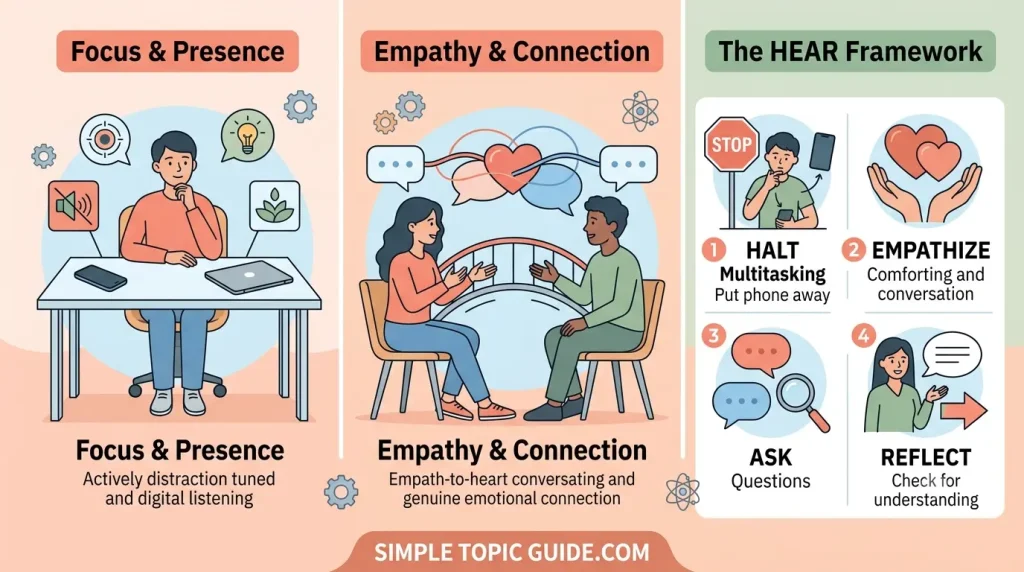
If you want to practice active listening in your day-to-day life, use the simple HEAR framework as a practical mental checklist:
1.1. H – Halt Multitasking:Eliminate Distractions.
You cannot actively listen while scrolling through social media, answering emails, or staring at a TV screen in the background. Put your device face down, close laptop tabs, and give the speaker your undivided physical presence. Eye contact and open posture instantly signal that the speaker has a safe space to share.
2.2. E – Empathize Before Answering:Validate Emotions.
Resist the immediate urge to jump into “fix-it” mode or offer unsolicited advice. Most people share problems because they want empathy and validation, not a lecture. Validate their feelings first with simple statements like, “That sounds incredibly frustrating” or “I can see why you would feel that way.”
3.3. A – Ask Clarifying Questions:Seek Clarity.
Keep the conversation moving deeper by asking open-ended questions instead of closed yes-or-no questions. Use prompts like, “How did that make you feel?”, “What do you think your next step should be?”, or “Can you tell me a bit more about that part?” This proves you are genuinely invested in their experience.
4.4. R – Reflect and Paraphrase:Confirm Meaning.
Before shifting the topic or offering your own perspective, reflect back what you heard in your own words. Say something like, “So if I’m understanding correctly, you felt overwhelmed because the project deadline was moved without telling you?” This prevents misunderstandings and gives the speaker a chance to clarify if you misread them.
Common Listening Traps to Avoid
Even with the best intentions, it is easy to slip into conversational habits that shutdown meaningful dialogue. Watch out for these three common traps:
- The Advice Trap: Jumping in with solutions before the speaker has finished explaining their problem. Unless someone explicitly asks, “What should I do?”, assume they simply need to be heard and understood first.
- The “One-Up” Trap: Hijacking someone else’s story to share a bigger or more intense story of your own. If a friend mentions having a stressful commute, responding with “You think that’s bad? Wait until you hear about my commute!” shifts the focus away from them and turns the conversation into a competition.
- The Defensive Trap: Becoming defensive when someone brings up feedback or a criticism. When you listen defensively, you look for technical flaws in their wording rather than understanding their core emotion.
Conclusion: The Ultimate Superpower in Relationships
Active listening is far more than a basic communication technique; it is an act of respect and generosity. In a world where everyone is vying for attention, offering someone your full, unhurried, and non-judgmental presence is one of the most impactful gifts you can give.
By moving away from internal listening, applying the HEAR framework, and avoiding common conversational traps, you will quickly notice a profound shift in your daily interactions. Trust builds faster, conflicts de-escalate smoother, and your personal and professional relationships become significantly richer.

Shafeeq Gargal is an educator and learning enthusiast dedicated to demystifying complex concepts. With a background in technical problem solving and education, he creates clear, structured guides on personal finance, productivity, and modern technology to help readers build practical everyday skills.