When most people hear the word “budget,” they immediately think of restriction, sacrifice, and complicated spreadsheets that take hours to maintain. It feels like going on a strict financial diet where every fun purchase triggers a wave of guilt.
Because traditional budgeting feels so painful, most people abandon it entirely—leaving their financial future to guesswork and hope.
The truth is, effective money management shouldn’t feel like a punishment. A good budget doesn’t tell you to stop spending money; it simply gives your money a clear purpose before it leaves your account. If you want a simple, stress-free system that balances enjoying your life today with building wealth for tomorrow, the 50/30/20 Budgeting Rule is the ultimate framework to master.
What is the 50/30/20 Rule?
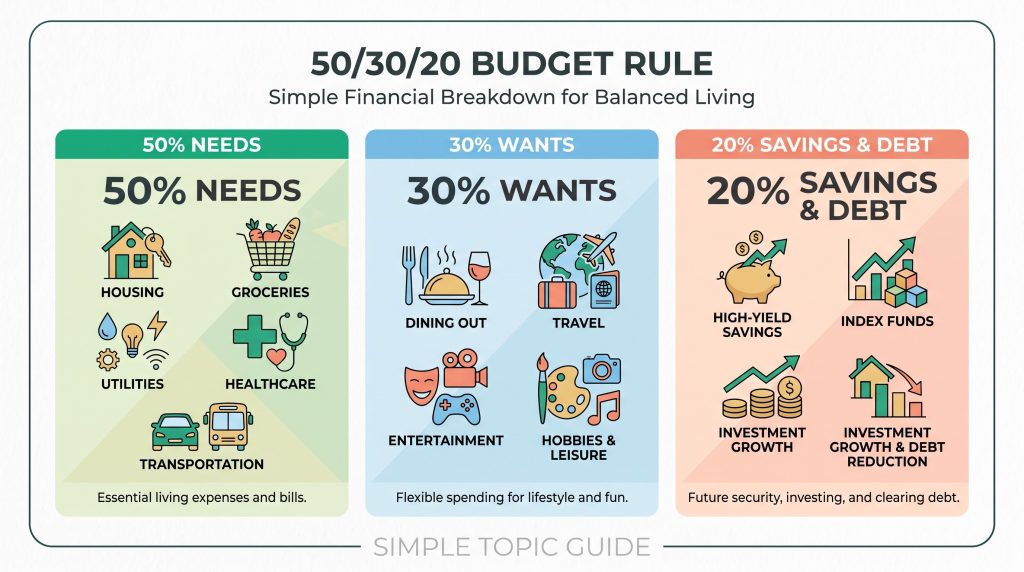
Popularized by Senator Elizabeth Warren in her book All Your Worth, the 50/30/20 rule is an intuitive proportion-based spending framework. Instead of tracking dozens of hyper-specific categories like “coffee shops” or “movie tickets,” you divide your net income (your after-tax, take-home pay) into three broad buckets:
+-----------------------------------------------------------------------+
|                       AFTER-TAX INCOME (100%)                         |
+--------------------------+--------------------+-----------------------+
|       50% NEEDS          |     30% WANTS      |  20% SAVINGS & DEBT   |
| Rent, Food, Utilities    | Dining, Hobbies    | Emergency Fund, SIPs  |
+--------------------------+--------------------+-----------------------+
Breaking Down the 3 Buckets
1. 50% of Income: Needs (Essential Survival Expenses)
Needs are the non-negotiable expenses required to keep a roof over your head, food on your table, and basic utilities running. If you were to lose your job tomorrow, these are the costs you would still have to pay to survive.
- What’s Included:
- Rent or mortgage payments
- Basic groceries (excluding fancy dining out)
- Utilities (electricity, water, cooking gas, internet)
- Transportation (fuel, public transit, essential auto loans)
- Basic health insurance and minimum debt payments
- The Golden Rule: If your essential needs exceed 50% of your net income, you are living “house poor” or over-leveraged. You may need to look at downsizing housing, reducing utility waste, or finding ways to increase your core income.
2. 30% of Income: Wants (Lifestyle Choices)
Wants are all the extra things you spend money on that are not essential for survival, but make life enjoyable. This is the bucket that traditional budgets try to eliminate—and why traditional budgets usually fail.
- What’s Included:
- Dining out, food delivery, and coffee shop visits
- Subscriptions (Netflix, Spotify, gym memberships)
- Vacations, weekend trips, and travel
- Hobbies, shopping for non-essential clothes, and entertainment
- The Golden Rule: You are fully allowed to spend this 30% without an ounce of guilt! As long as your Needs are capped at 50% and your Savings hit 20%, your Wants bucket gives you complete financial freedom to enjoy your lifestyle.
3. 20% of Income: Savings & Wealth Building
This is the engine of your financial freedom. The 20% bucket is dedicated to securing your future self, protecting against emergencies, and building long-term wealth.
- What’s Included:
- Building a 3 to 6-month emergency fund
- Investing in retirement accounts, index funds, or systematic investment plans (SIPs)
- Accelerating high-interest debt payoffs (paying above the minimums)
- Saving for major life goals (down payment on a house, starting a business)
- The Golden Rule: Treat your savings like an essential bill. Pay your future self first on payday rather than saving whatever scraps happen to be left over at the end of the month.
What If Your Needs Exceed 50%? (The Real-World Adjustment)
In an era of rising inflation and high housing costs, sticking strictly to 50% for essential needs can feel nearly impossible—especially if you live in a major city or are just starting your career. If your rent, utilities, and groceries consume 60% or 70% of your income, don’t throw the entire system away.
The 50/30/20 rule is a flexible guidepost, not an inflexible law. Here is how to adjust the ratios while working your way back toward balance:
- Protect the 20% Savings Bucket: Avoid the temptation to steal money from your savings bucket to fund your lifestyle. Prioritizing at least 10% to 15% in savings keeps your long-term safety net intact.
- Borrow from the Wants Bucket: If your Needs claim 65% of your income, temporarily shrink your Wants bucket from 30% down to 15% or 20%.
- Focus on Income Expansion: Cutting back on coffee or dining out can save hundreds, but lowering your housing or increasing your salary saves thousands. Treat a high “Needs” percentage as a trigger to negotiate a raise, take on freelance work, or look for lower fixed overhead over time.
Step-by-Step: How to Put the 50/30/20 Rule into Action
1.1. Know Your True Take-Home Pay:Calculate Net Income.
Look at your bank account statement and identify your actual monthly take-home pay after taxes and mandatory deductions. If you are a freelancer or have variable income, use the average of your last 3 to 6 months.
2.2. Multiply by 0.50, 0.30, and 0.20:Set Your Cap.
For example, if your monthly take-home pay is $4,000 (or ₹50,000):
• Needs Cap (50%): $2,000 (or ₹25,000)
• Wants Cap (30%): $1,200 (or ₹15,000)
• Savings Target (20%): $800 (or ₹10,000)
3.3. Categorize Past Expenses:Audit Spending.
Review your last 30 days of bank transactions. Place each purchase into Needs, Wants, or Savings. See where your current numbers diverge from the 50/30/20 benchmark and adjust your spending dials accordingly.
Common Pitfalls: The Line Between “Need” vs. “Want”
The biggest reason people struggle with the 50/30/20 rule is that they trick themselves into reclassifying Wants as Needs.
- Groceries are a Need; gourmet organic meal delivery kits are a Want.
- A basic phone plan is a Need; upgrading to the newest flagship smartphone every year is a Want.
- A pair of work shoes is a Need; designer sneakers are a Want.
Be brutally honest with your categorization. When you get accurate about your true needs, you free up the bandwidth required to build real wealth.
Automating Your Financial System
The real secret to making the 50/30/20 budget effortless is automation. Don’t rely on willpower.
- Set up an automatic transfer on payday that immediately moves 20% of your check directly into a separate high-yield savings or investment account.
- Pay your 50% essential bills (rent, utilities, insurance) immediately.
- Whatever remains in your checking account is your 30% Wants bucket. You can spend every cent of it until the next paycheck guilt-free, knowing your bills are paid and your future is growing.
The Psychological Power of Guilt-Free Spending
The primary reason traditional budgets fail is psychological exhaustion. When a budget treats every single discretionary purchase as a failure of willpower, it triggers a “what the-hell” effect: after overspending slightly on one weekend, people feel defeated and abandon the budget altogether.
The 50/30/20 framework completely eliminates this guilt by creating walled gardens for your money:
- Peace of Mind: Once your 50% Needs are covered and your 20% Savings are automatically transferred, the money left in your 30% Wants bucket is entirely free game.
- No Micro-Management: You don’t need to track whether you bought three lattes or four, or if you spent slightly more on clothing than on video games.
- Intentional Enjoyment: You can spend every single dollar in that 30% bucket on whatever brings you joy, knowing that your bills are fully paid and your financial future is already growing on autopilot.
Conclusion: Sustainable Wealth Over Extreme Frugality
Financial literacy isn’t about counting pennies or living a life of self-denial. It is about creating a clear, repeatable system that respects both your present happiness and your future security.
By sticking to the 50/30/20 rule, you replace financial anxiety with clarity. You build a safety net, grow your wealth automatically, and retain the freedom to enjoy the things you love today.

Shafeeq Gargal is an educator and learning enthusiast dedicated to demystifying complex concepts. With a background in technical problem solving and education, he creates clear, structured guides on personal finance, productivity, and modern technology to help readers build practical everyday skills.