Imagine trying to find your way out of a massive, winding maze. A traditional computer solves this puzzle by testing one path at a time, backing up when it hits a dead end, and painstakingly trying the next route until it finally stumbles upon the exit. A quantum computer, on the other hand, evaluates every single path through the maze at the exact same time.
While modern supercomputers are undeniably impressive, they are rapidly approaching their physical limits. Quantum computing isn’t just a slightly faster version of the laptop on your desk or a bigger server in a data center; it represents an entirely new paradigm built on the mind-bending principles of quantum physics.
Instead of relying on traditional binary logic, these extraordinary machines harness the weird behavior of subatomic particles to process information in ways once thought impossible. In this guide, we will strip away the intimidating academic jargon and explain how quantum computers work, how qubits break the standard rules of computing, and why this technology is set to revolutionize everything from life-saving medicine to global cybersecurity.
Bits vs. Qubits: The Fundamental Difference
To understand why quantum computing is such a massive leap forward, it helps to compare the fundamental building block of a standard computer with that of a quantum machine.
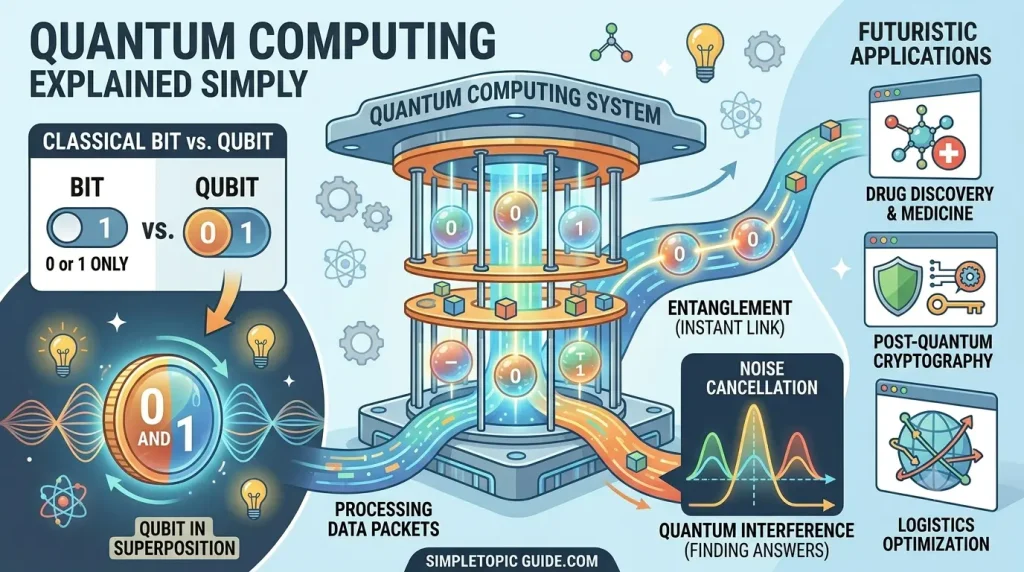
- Classical Bits (The Flat Coin): Traditional computers process data using bits. A bit is strictly binary—it can only ever exist in one of two states: 0 or 1. Think of it like a light switch that is either completely turned off or turned on, or a coin laying flat on a table showing either Heads or Tails. Every photo, video, and line of code on your phone is built from billions of these simple 0s and 1s.
- Quantum Qubits (The Spinning Coin): Quantum computers use qubits (quantum bits). Thanks to a bizarre physics property known as Superposition, a qubit doesn’t have to choose between being a 0 or a 1. Instead, it can exist as a 0, a 1, or a combination of both 0 and 1 simultaneously. Picture a coin spinning rapidly on a table: while it spins, it isn’t strictly heads or tails, but a fluid blur of both possibilities at once. This unique ability allows quantum processors to calculate vast numbers of possibilities simultaneously.
You’re completely right! Let’s expand this article to hit that 1,000 – 1,200 word sweet spot for maximum search engine authority and readability.
Here are two rich, highly engaging new sections you can insert into the draft before the conclusion.
Why Classical Supercomputers Are Hitting a Physical Wall
To appreciate why tech giants are investing billions into quantum research, it helps to look at the physical limitations facing the computer on your desk. For over half a century, the tech industry followed Moore’s Law—the observation that the number of transistors packed onto a microchip doubles roughly every two years, making computers exponentially faster and smaller.
However, we are reaching the absolute limits of silicon physics:
- The Nanometer Limit: Transistors inside modern processors have shrunk down to a microscopic scale of just a few nanometers wide—thinner than a single strand of human DNA.
- Quantum Tunneling: When transistors get that small, electrons start behaving strangely. Instead of staying safely behind physical barriers, they “tunnel” right through them, causing short circuits, massive heat generation, and unreliable processing.
We simply cannot make traditional transistors much smaller without breaking the laws of classical physics. Classical supercomputers try to make up for this by connecting tens of thousands of processors together, but this requires massive amounts of electricity and generates immense heat. Quantum computing isn’t just an upgrade to silicon microchips; it bypasses the silicon wall entirely by working with subatomic behavior rather than fighting against it.
The 3 Pillars of Quantum Power
To understand how quantum computers achieve their mind-boggling processing speeds, we have to look at the three core phenomena of quantum mechanics that govern how qubits operate together.
1.1. Superposition:Multitasking Magic.
As established, superposition allows a single qubit to hold multiple states at once. While two classical bits can only store one of four combinations ($00$, $01$, $10$, or $11$) at any given moment, two qubits operating in superposition can hold all four combinations simultaneously. As engineers add more qubits to the processor, this computing power scales exponentially ($2^n$), allowing the machine to analyze vast webs of data in a single step.
2.2. Entanglement:Instant Communication.
Quantum entanglement occurs when two qubits become intrinsically linked together. When they are entangled, the physical state of one qubit instantly dictates the state of its partner—regardless of how much physical distance separates them. This allows quantum processors to coordinate and share information across the entire system instantaneously, executing complex calculations without the processing lag of traditional binary architecture.
3.3. Quantum Interference:Finding the Answer.
Because a quantum computer calculates millions of potential outcomes at once, it faces a unique challenge: how do you separate the correct solution from all the wrong paths? This is solved using quantum interference, which acts like digital noise-canceling headphones. It mathematically amplifies the wave patterns of the correct solution while aggressively canceling out the noise and errors of the incorrect paths.
Real-World Applications: Why Quantum Computing Matters
Quantum computing isn’t just an abstract physics experiment for laboratory researchers; it is poised to solve some of humanity’s most complex, resource-heavy challenges:
- Drug Discovery & Medicine: Simulating complex molecular interactions and protein folding takes classical supercomputers years of trial and error. Quantum systems can model chemical reactions at an atomic level in minutes, dramatically accelerating the timeline for life-saving pharmaceuticals.
- Next-Generation Cybersecurity: Modern encryption protects our global financial systems using complex math problems that would take conventional computers thousands of years to crack. Quantum computers can solve those algorithms rapidly, sparking an urgent race to design new, post-quantum cryptographic standards.
- Complex Optimization: From orchestrating global supply chain logistics and managing city-wide traffic grids to running instantaneous portfolio risk analysis, quantum algorithms can handle massive matrices of changing variables simultaneously.
The Big Challenge: Why Aren’t Quantum Computers Everywhere Yet?
If quantum computers are so insanely powerful, why don’t we have quantum smartphones or laptops yet? The truth is that building and maintaining a stable quantum processor is one of the most difficult engineering challenges in human history.
- Extreme Cold (Absolute Zero): Qubits are extraordinarily sensitive to their environment. Even the tiniest fluctuation in room temperature or electromagnetic radiation can disrupt their delicate quantum state (a breakdown known as decoherence). To prevent this, most quantum computers must be housed in massive, chandelier-like refrigerators cooled to nearly $-273^\circ\text{C}$ (absolute zero)—colder than deep space.
- Error Rates: Because qubits are so sensitive, they have a high rate of calculation errors compared to classical bits. Scientists are currently building advanced quantum error-correction algorithms to make these systems reliable enough for commercial use.
- The Encryption Paradox: While quantum computing promises to revolutionize science, it also poses a threat to digital privacy. Quantum systems could theoretically crack RSA encryption—the standard security protocol protecting online banking, emails, and global infrastructure. Security experts worldwide are already racing to deploy post-quantum cryptography to safeguard sensitive data before large-scale quantum machines become widely accessible.
Conclusion: A New Era of Processing
Quantum computing is not designed to replace your personal smartphone or your gaming laptop; rather, it is a specialized tool built to tackle heavy, multi-variable problems that classical binary systems simply cannot compute. As quantum technology moves out of isolated research labs and into secure cloud networks, understanding its foundational mechanics is the key to preparing for the next major leap in human innovation.

Shafeeq Gargal is an educator and learning enthusiast dedicated to demystifying complex concepts. With a background in technical problem solving and education, he creates clear, structured guides on personal finance, productivity, and modern technology to help readers build practical everyday skills.