Have you ever spent an entire day working non-stop, checking off task after task, only to collapse on the couch at night feeling as though you accomplished nothing meaningful?
This is the modern productivity paradox. In a world flooded with instant messaging apps, push notifications, and unending to-do lists, we are constantly busy, but rarely productive. We mistake motion for progress. We react to whichever email screams the loudest, jump from one minor fire to the next, and leave our most significant personal and professional goals pushed to “someday.”
To break free from this exhausting reactive cycle, you don’t need more hours in the day—you need a better filter for decision-making. Enter the Eisenhower Matrix, a simple yet transformative time-management framework created by Dwight D. Eisenhower, 34th President of the United States and Allied Supreme Commander during WWII.
By organizing your tasks into four clear quadrants based on urgency and importance, this tool helps you stop reacting to short-term distractions and start investing in long-term success.
The Crucial Distinction: Urgent vs. Important
Before filling out the matrix, you must understand the fundamental difference between what is urgent and what is important. The human brain naturally suffers from what psychologists call the Urgency Effect—a bias that tricks us into prioritizing tasks with pressing deadlines, even when they offer minimal real value.
+-----------------------------------------------------------------------+
| URGENT TASKS                                                          |
| Demands immediate attention. Driven by external pressure & deadlines. |
| Examples: Phone calls, alarms, pop-up requests, breaking news.       |
+-----------------------------------------------------------------------+
                                   vs
+-----------------------------------------------------------------------+
| IMPORTANT TASKS                                                       |
| Contributes to long-term goals, core values, & personal growth.       |
| Examples: Strategic planning, exercise, skill building, family time.  |
+-----------------------------------------------------------------------+
- Urgent tasks demand immediate action. They are reactive, often defined by someone else’s timeline, and trigger a sense of pressure or stress if ignored.
- Important tasks contribute directly to your long-term vision, core values, and major objectives. They require deliberate intention, focus, and initiative because they rarely come with an immediate siren or ticking timer.
The 4 Quadrants Breakdown
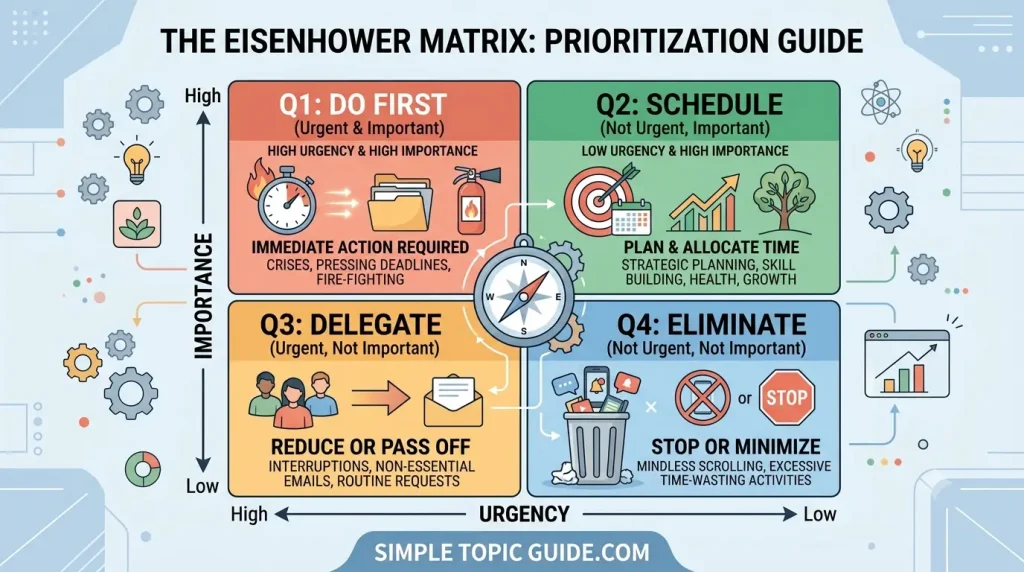
The Eisenhower Matrix plots your tasks along two axes: Urgency (Horizontal) and Importance (Vertical), creating four distinct quadrants that dictate your action plan:
| Urgent | Not Urgent | |
| Important | Quadrant 1: DO (Crises, pressing deadlines) | Quadrant 2: SCHEDULE (Growth, planning, health) |
| Not Important | Quadrant 3: DELEGATE (Interruptions, minor requests) | Quadrant 4: ELIMINATE (Mindless scrolling, time-wasters) |
Quadrant 1: DO (Urgent & Important)
This is the Crisis Zone. Tasks in Quadrant 1 cannot be delayed; they require immediate action because failure to address them carries severe consequences.
- Examples: A server crash at work, a sick child, a pipe leaking under the sink, or a project due in two hours.
- Strategy: Handle these immediately, but aim to reduce how much time you spend here. Living permanently in Quadrant 1 leads directly to chronic stress and burnout.
Quadrant 2: SCHEDULE (Not Urgent, but Important)
This is the Growth Zone—the sweet spot of high performance and long-term fulfillment. These tasks build your future, but because they lack an aggressive deadline, they are the easiest to procrastinate on.
- Examples: Regular physical exercise, learning a new career skill, building deep relationships, proactive maintenance, and long-term financial planning.
- Strategy: Block dedicated time on your calendar for these activities. Guard this time fiercely, treating appointments with yourself just as seriously as a meeting with your boss.
Quadrant 3: DELEGATE (Urgent, but Not Important)
This is the Deception Zone. Tasks here feel important because they are urgent, but they actually serve someone else’s priorities rather than your own.
- Examples: Phone calls during deep work, last-minute requests for non-essential tasks, answering routine emails instantly, or attending status update meetings that could have been an email.
- Strategy: Say no, automate, or delegate these tasks whenever possible. Use template responses, pass tasks to team members, or batch communications into specific windows during the day.
Quadrant 4: ELIMINATE (Not Urgent & Not Important)
This is the Waste Zone. Activities in Quadrant 4 offer neither immediate value nor long-term progress. They are passive distractions disguised as rest.
- Examples: Mindlessly scrolling through social media, binge-watching TV shows out of boredom, excessively re-organizing a desktop folder, or getting sucked into online drama.
- Strategy: Cut these out aggressively. While true rest and genuine leisure belong in Quadrant 2 as intentional recovery, Quadrant 4 activities leave you feeling depleted and guilty.
The Quadrant 2 Trap: Why We Ignore What Matters Most
Understanding the Eisenhower Matrix on paper is easy, but executing it in real life reveals a frustrating psychological hurdle known as the Urgency Trap.
Human beings are wired to seek out immediate dopamine hits. Finishing a quick, urgent task—like clearing an unread email badge, responding to a text, or checking off a simple Quadrant 3 chore—provides instant gratification. Our brains register these minor tasks as “wins,” even if they do nothing to move the needle on our life goals.
Conversely, Quadrant 2 tasks (such as writing a book, building a fitness routine, or developing a strategic business plan) rarely offer immediate rewards. They require sustained cognitive effort, deep focus, and emotional discomfort without guaranteed short-term results.
Because Quadrant 2 activities never scream for your attention with ticking timers or ringing phones, they are perpetually vulnerable to being pushed to tomorrow. The hard truth is that tomorrow never comes unless it is scheduled. If you rely on “feeling like it” or waiting for free time to appear, Quadrant 1 crises and Quadrant 3 interruptions will consume 100% of your day, every day.
How to Apply the Eisenhower Matrix Every Day
1.1. Capture Everything:Brain Dump.
At the start or end of each day, write down every single task, errand, meeting, and idea swirling in your head onto a master list without filtering them yet.
2.2. Assign Each Task to a Quadrant:Categorize.
Go through your master list item by item and ask two honest questions: Is this truly urgent? Is this deeply important to my long-term goals? Place each task into Q1, Q2, Q3, or Q4.
3.3. Limit Q1 & Protect Q2:Execute.
Execute your Q1 tasks first. Once those immediate fires are out, immediately shift your energy to your scheduled Q2 time blocks before opening your inbox or tackling Q3 requests.
Common Pitfalls When Implementing the Matrix (And How to Fix Them)
Even experienced planners run into trouble when first adopting this matrix. Here are three common traps to watch out for as you build your prioritization habit:
1. Mislabeling Quadrant 3 as Quadrant 1
- The Mistake: Treating every request from a boss, client, or coworker as a life-or-death crisis simply because they marked it as urgent.
- The Fix: Pause before reacting. Ask yourself: “What is the actual consequence if this gets delayed by 4 hours or answered during my dedicated communication window?” If the world won’t end, it isn’t Quadrant 1.
2. Overcrowding Quadrant 2
- The Mistake: Trying to schedule 10 major long-term goals at once. This leads to decision paralysis and overwhelm.
- The Fix: Limit your active Quadrant 2 focus to 1 to 3 key priorities per week. Deep progress on a few meaningful goals is far more effective than shallow effort spread across a dozen.
3. Confusing Quadrant 4 (Distraction) with True Rest
- The Mistake: Believing that scrolling through social media or watching random videos for two hours counts as necessary relaxation.
- The Fix: True rest recharges your battery; Quadrant 4 drains it. Reclassify genuine recovery—like taking a walk, reading a physical book, meditating, or spending quality time with friends—as Quadrant 2 activities and schedule them intentionally.
Conclusion: From Reactive Stress to Proactive Freedom
Mastering the Eisenhower Matrix isn’t about packing more tasks into your day; it is about choosing what not to do so you can devote your energy to what truly matters.
When you stop letting urgency dictate your actions, you regain control over your time, reduce cognitive fatigue, and make steady, measurable progress toward your most ambitious personal and professional goals.

Shafeeq Gargal is an educator and learning enthusiast dedicated to demystifying complex concepts. With a background in technical problem solving and education, he creates clear, structured guides on personal finance, productivity, and modern technology to help readers build practical everyday skills.