Life rarely goes according to a perfect script. No matter how meticulously you plan your career, finances, or relationships, unexpected storms will inevitably knock you off course. A project you spent months on gets canceled, a relationship ends, a financial emergency hits, or a sudden health challenge arises.
When life hits hard, what determines whether you break down or adapt? The answer isn’t luck, superior intelligence, or an absence of emotion—it is emotional resilience.
Emotional resilience is not the ability to ignore pain, suppress sadness, or pretend everything is fine. Rather, it is the psychological capacity to absorb adversity, adapt to changing circumstances, and bounce back stronger than before. Like a physical muscle, resilience isn’t something you are simply born with; it is an active skill that anyone can build through practice and intention.
The 3 C’s Framework of Resilience
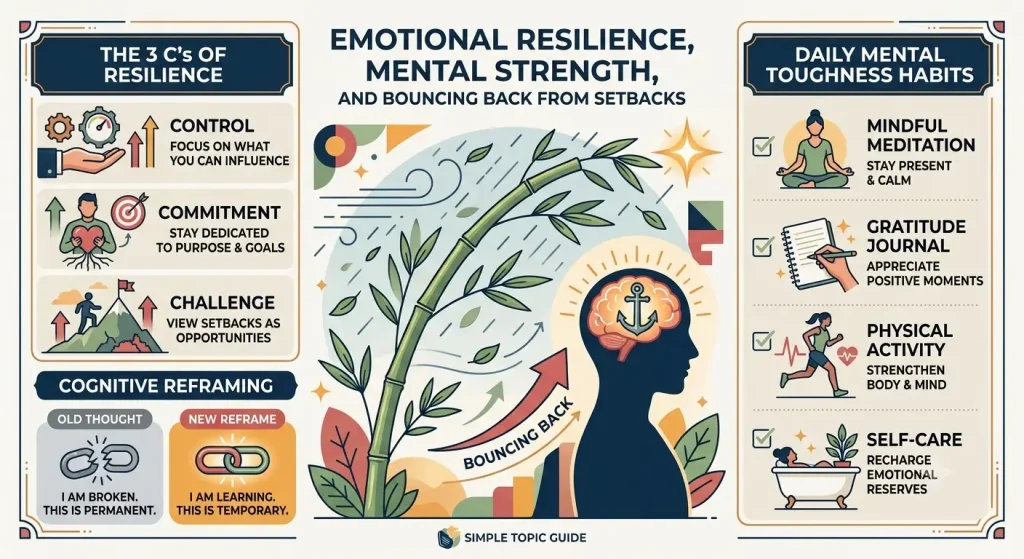
Psychologist Dr. Suzanne Kobasa spent decades studying individuals who thrived under extreme stress and uncertainty. She discovered that resilient people share three core psychological attitudes, known as The 3 C’s of Resilience:
+-----------------------------------------------------------------------+
|                             CONTROL                                   |
| Focus strictly on what you can influence; accept what you cannot.     |
+-----------------------------------------------------------------------+
                                   │
                                   ▼
+-----------------------------------------------------------------------+
|                            COMMITMENT                                 |
| Stay anchored to your purpose, relationships, and long-term values.  |
+-----------------------------------------------------------------------+
                                   │
                                   ▼
+-----------------------------------------------------------------------+
|                             CHALLENGE                                 |
| View setbacks as temporary lessons rather than permanent failures.   |
+-----------------------------------------------------------------------+
1. Control (Internal Locus of Control)
Resilient people recognize that while they cannot control external events, they retain 100% control over their responses. When faced with a crisis, non-resilient individuals waste energy asking, “Why did this happen to me?” Resilient individuals immediately pivot, asking, “What can I do about this right now?”
2. Commitment
When severe adversity hits, it is tempting to retreat into isolation or abandon your goals entirely. Resilient individuals stay engaged with their life. They remain committed to their work, health, family, and personal values, using these core pillars as anchors during difficult times.
3. Challenge
Resilient individuals view life’s obstacles as natural opportunities for growth rather than personal, permanent catastrophes. Instead of expecting smooth sailing, they accept that change and difficulty are natural parts of the human experience.
You’ve got a sharp eye! Let’s expand Article 4: How to Build Emotional Resilience to bring it squarely into that 1,000 – 1,200 word target.
Here are two rich, highly actionable sections to insert into the draft before the conclusion.
Post-Traumatic Growth: Growing Beyond Your Baseline
When adversity hits, most people view recovery as simply returning to where they were before the crisis—getting back to baseline. However, psychological research into Post-Traumatic Growth (PTG) reveals that severe challenges often act as a catalyst for individuals to exceed their original baseline, developing deeper wisdom and personal strength.
Post-traumatic growth doesn’t mean the crisis was good or desirable; it means the process of struggling with adversity forced meaningful transformation in five key areas:
- Appreciation of Life: Minor everyday hassles lose their power to upset you, while small, simple daily moments bring far greater joy.
- Personal Strength: Experiencing and surviving a major setback provides tangible proof of your endurance (“If I survived that, I know I can handle this”).
- Relational Connection: Shared vulnerability during tough times deepens empathy and strengthens personal bonds with friends, family, and community.
- New Possibilities: A door closing often forces you out of comfortable ruts and compels you to explore new career, creative, or life paths you otherwise would have ignored.
- Clarity of Priorities: Setbacks act as a powerful filter, helping you instantly distinguish between what actually matters and what is just superficial noise.
Cognitive Reframing: Changing Your Internal Script
When a sudden setback occurs, our default instinct is often to fall into negative thinking loops. Cognitive reframing is the practice of identifying these mental traps and intentionally replacing them with constructive, empowering perspectives.
| Unhelpful Thought Trap | Resilient Cognitive Reframe |
| “Everything is completely ruined.” (Catastrophizing) | “This specific situation is difficult, but it doesn’t ruin the rest of my life.” |
| “I failed, so I must be incompetent.” (Personalizing) | “This approach failed, but it gives me valuable feedback to try again.” |
| “Things will never get better.” (Permanence) | “This pain is temporary. I have navigated tough times before, and I will get through this.” |
4 Daily Habits That Build Mental Toughness
Building emotional strength isn’t about grand gestures during a crisis; it is built through small, consistent habits practiced every day:
1.1. Practice the Circle of Influence:Control the Controllables.
Draw two concentric circles on a piece of paper. In the outer circle, write things you are worried about but cannot change (the economy, other people’s actions, past mistakes). In the inner circle, write things you can control today (your reaction, effort, schedule, and attitude). Channel all your energy into the inner circle.
2.2. Journal for Emotional Clarity:Process, Don’t Suppress.
Suppressing difficult emotions creates psychological friction that burns energy. Spending just 10 minutes writing stream-of-consciousness thoughts in a journal allows you to process emotions cleanly, step back, and evaluate the facts objectively.
3.3. Guard Your Physical Foundation:Build Physical Resilience.
Mental strength is deeply linked to physical health. Sleep deprivation, poor nutrition, and lack of exercise lower your threshold for emotional stress. Prioritizing movement and sleep gives your brain the biological bandwidth to manage anxiety.
4.4. Cultivate Your Support Network:Avoid Isolation.
Resilience is not a solo journey. Having a trusted friend, family member, mentor, or professional to talk to during tough times provides perspective and reminds you that you don’t have to carry burdens alone.
The Danger of Toxic Positivity
It is important to distinguish between true emotional resilience and toxic positivity.
Toxic positivity is the unhelpful forcing of a happy facade, suppressing valid emotions like grief, frustration, or fear with phrases like “just stay positive!” This approach causes deeper psychological harm because it invalidates genuine human pain.
True resilience requires honoring your feelings first. It is okay to feel hurt, angry, or sad after a failure. Resilience simply means allowing yourself to feel those emotions fully without letting them trap you permanently.
The Post-Crisis Audit: Turning Pain into Perspective
Once the immediate emotional storm has passed and you have stabilized the situation, resilient individuals conduct a Post-Crisis Audit. Instead of trying to instantly forget the painful experience, they analyze it objectively to convert temporary suffering into permanent life wisdom.
Ask yourself these four reflective questions once the emotional dust settles:
1.1. What was within my control, and what was completely outside it?:Fact Check.
Identify where you spent your energy during the crisis. Did you waste time trying to control someone else’s reaction, or did you focus on your own actions?
2.2. What hidden blind spot or skill gap did this setback reveal?:Skill Gap.
Did the crisis highlight a need for better financial savings, stronger personal boundaries, clearer communication, or better health habits?
3.3. Who or what was most helpful during this process?:Resource Check.
Take note of the habits, mental frameworks, or people who genuinely helped you navigate the storm so you know where to lean next time.
4.4. How can I use this experience to help someone else?:Future Proofing.
Sharing your story and lessons with others facing similar struggles turns your past pain into a source of value and connection.
Conclusion: Becoming the Tree That Bends
In a storm, the rigid oak tree breaks because it refuses to yield, while the flexible bamboo tree bends with the wind and remains standing after the tempest passes.
Resilience is not about being unbreakable; it is about being flexible. By embracing The 3 C’s, practicing cognitive reframing, and cultivating daily habits of self-care, you build an internal anchor that keeps you steady—no matter how hard the wind blows.

Shafeeq Gargal is an educator and learning enthusiast dedicated to demystifying complex concepts. With a background in technical problem solving and education, he creates clear, structured guides on personal finance, productivity, and modern technology to help readers build practical everyday skills.