Step into any cryptocurrency online community, and you will instantly be bombarded with wildly conflicting advice. One faction of investors will adamantly tell you to “buy and HODL” your favorite coins for the long haul, while another proudly flashes screenshots of massive 100% profits captured in a single hour using complex, fast-moving trading charts. It can leave anyone looking to enter the market feeling completely overwhelmed. How can two people look at the exact same digital asset and approach it with such entirely different philosophies?
The answer is that while both groups are participating in the crypto market, they are playing completely different games. The division comes down to two primary trading mechanisms: Spot Trading and Futures Trading.
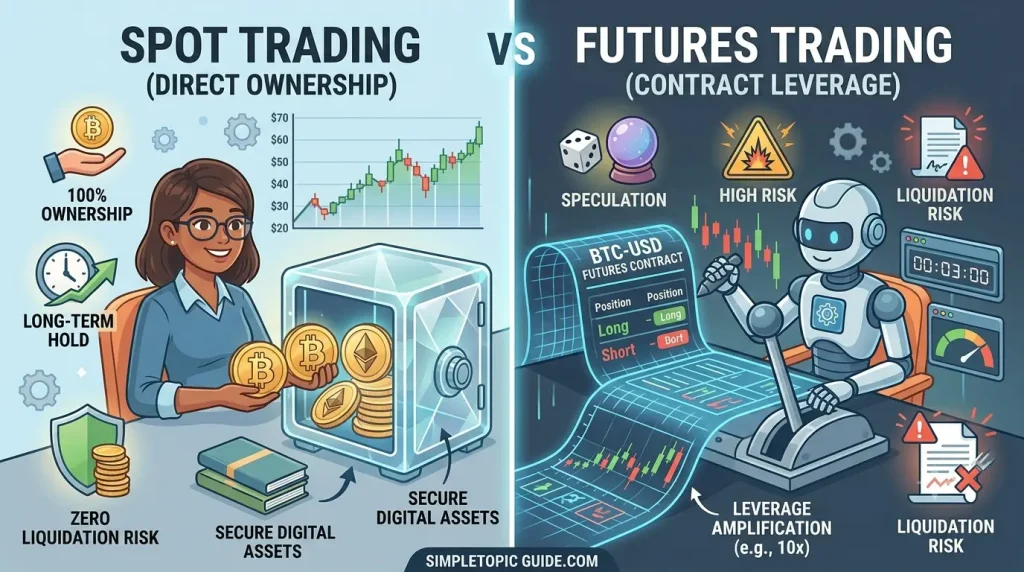
At its core, the difference is simple: one method is built around direct asset ownership, while the other is built around pure price speculation. When you trade on the spot market, you are buying the actual digital property—like purchasing a piece of land that you fully own and can hold onto forever. When you enter a futures contract, you aren’t buying the coin at all; you are entering a financial wager on which direction that coin’s price will move next. In this beginner-friendly guide, we are going to strip away the confusing financial jargon, break down how these two ecosystems work, and explore the crucial concept of leverage so you can safely choose the path that fits your financial goals.
What is Crypto Spot Trading? (Direct Ownership)
Spot trading is the most straightforward, intuitive way to interact with cryptocurrency. The term “spot” comes from the fact that you are buying or selling an asset right there “on the spot” for immediate settlement and delivery.
When you buy a cryptocurrency on the spot market, you execute a direct financial exchange. If you spend money to buy Bitcoin or Ethereum, that fractional piece of cryptocurrency is immediately transferred to you. You fully own it. It sits securely inside your digital exchange wallet, and you have complete control over it. You can transfer it to a private hardware wallet, hold it for five years, use it to purchase goods, or stake it to earn passive interest.
The biggest advantage of spot trading for beginners is its bounded, manageable risk profile. If the crypto market experiences a massive downturn tomorrow, the dollar value of your portfolio will drop, but the exact amount of crypto you own remains unchanged. If you own 0.5 Ethereum, you still own 0.5 Ethereum regardless of what the charts say. You only realize a financial loss if you panic-sell your coins at a lower price than you bought them. Because you pay 100% upfront for what you buy, your risk is strictly capped at the initial amount you spent—your account can never be wiped out by market volatility.
What is Crypto Futures Trading? (Speculation & Contracts)
Futures trading works entirely differently from the traditional buy-and-hold model. Instead of purchasing the actual underlying coin, you are buying or selling a financial derivative contract that tracks the asset’s real-time price index. You never actually touch, own, or transfer the cryptocurrency itself; instead, you are entering a formal wager with the market regarding its next move.
Because you are trading contracts rather than physical tokens, futures markets give you the unique ability to profit in any market condition:
- Going Long: If your research suggests a coin’s price is about to skyrocket, you buy a “Long” contract. You profit as the price moves upward.
- Going Short: If you believe a coin’s price is bound to crash, you sell a “Short” contract. This allows you to generate a profit as the asset’s value actively drops—a powerful tool for hedging long-term portfolios during a bear market.
The Double-Edged Sword: Leverage and Liquidation
The primary reason traders flock to the futures market is a high-octane mechanism called leverage. Leverage allows you to borrow capital from the trading platform to control a significantly larger financial position than your actual account balance would allow.
For example, if you allocate a margin deposit of ₹1,000 using 10x leverage, the exchange effectively loans you the rest so you can trade a position worth ₹10,000.
- The Upside: If the asset’s price moves in your favor by a mere 5%, your 10x leveraged position yields a 50% return on your initial ₹1,000 investment.
- The Downside: If the price moves against you by that same 5%, your initial investment is immediately slashed by 50%.
This extreme volatility introduces the ultimate risk unique to futures trading: liquidation. Because the exchange loaned you the capital to trade, it will not allow you to lose more money than you deposited as collateral. If a market swing moves so far against you that your losses equal your initial deposit, the exchange will forcefully close your position to protect its own capital. In a flash, your trade is liquidated, and your allocated account balance is instantly wiped to zero.
Spot vs. Futures: A Side-by-Side Reality Check
To help you visualize how these two environments compare before making a financial decision, let’s look at their structural differences side-by-side:
| Trading Metric | Spot Trading 🪙 | Futures Trading 📈 |
| Asset Ownership | Yes (The actual tokens are fully yours) | No (You hold a contractual price agreement) |
| Leverage Available | None (You must pay 100% upfront) | Yes (Ranging typically from 2x up to 50x+) |
| Market Direction | Only profitable when prices rise | Profitable when prices rise or fall |
| Liquidation Risk | Zero (You can safely hold through any market dip) | High (A small wrong move can wipe out your margin) |
| Primary Use Case | Building long-term wealth and portfolios | Short-term active trading and risk hedging |
Which Path Should You Choose?
Deciding between these two markets comes down to an honest assessment of your personal risk tolerance, available time, and trading experience.
Choose Spot Trading If:
- Your goal is to steadily build a long-term investment portfolio through strategies like Dollar-Cost Averaging (DCA).
- You don’t want the stress of monitoring fast-changing candles and trading charts every hour.
- You want the mental peace of knowing that no matter how low the market dips, your assets can never be forcefully taken from you.
Choose Futures Trading Only If:
- You have spent months mastering technical analysis, reading order books, and managing risk parameters.
- You want to actively protect (hedge) your existing spot investments during a predicted market downturn.
- You are utilizing strict stop-loss orders and are entirely comfortable with the high probability of losing 100% of the specific capital you allocate to a trade.
Conclusion: Patience vs. Precision
At the end of the day, spot trading is a game of patience and asset ownership, while futures trading is a fast-paced game of precision, speculation, and leverage. For the vast majority of beginners stepping into the digital asset space, building a firm foundation in the spot market is the safest, most logical way to understand how market cycles move before ever testing the waters of a leveraged contract.
Your Financial Literacy Checklist
Before publishing this comparison guide, verify it delivers a balanced, safety-first perspective for your audience:
- [ ] Ownership Distinction: Is it completely clear that spot buyers own real coins while futures traders own price-tracking contracts?
- [ ] Leverage Explained: Did you successfully illustrate how leverage multiplies both potential winnings and potential losses?
- [ ] The Liquidation Warning: Is the concept of an exchange wiping a position to zero clearly highlighted as a warning?
- [ ] Audience Filtering: Does the conclusion provide actionable criteria to guide beginners away from high-risk environments?

Shafeeq Gargal is an educator and learning enthusiast dedicated to demystifying complex concepts. With a background in technical problem solving and education, he creates clear, structured guides on personal finance, productivity, and modern technology to help readers build practical everyday skills.