For the past few years, our relationship with artificial intelligence has felt like a massive, ongoing conversation. You open an app, type a clever prompt into a text box, and wait for a chatbot to spit back a perfectly formatted essay, a poem, or a block of programming code. It is incredibly impressive, but it also requires you to do all the heavy lifting: you have to think of the prompt, guide the machine step-by-step, copy-paste the output, and fix the errors. But what if artificial intelligence could stop just talking about tasks and start actually doing them for you?
We are currently witnessing a massive, generational shift in technology away from reactive text boxes and toward a powerhouse ecosystem known as AI Agents. While a standard chatbot acts like a digital textbook that sits quietly until you turn the page, an AI agent functions like an autonomous digital assistant. You don’t give it instructions on how to write sentences; you give it a high-level goal, and it works independently behind the scenes to make it happen.
Imagine the difference in practice: instead of asking a chatbot to write a generic travel itinerary for your next trip, you can tell an AI agent to open up your calendar, scan the live web for the cheapest flight options, cross-reference hotel reviews, and draft the booking confirmation emails automatically. It represents the jump from tools we converse with, to software that actively works on our behalf. In this guide, we will strip away the complex developer jargon and explore the fascinating four-part framework of how AI agents think, how they utilize digital tools, and why they are the undisputed next step in the evolution of the internet.
Chatbots vs. AI Agents: What’s the Difference?
To truly grasp how massive this technological leap is, it helps to look at a direct, side-by-side comparison of how a traditional chatbot operates versus how an autonomous AI agent approaches the exact same problem.
- The Chatbot (Reactive): Think of a chatbot as an incredibly smart, stationary consultant. It handles information in a rigid, one-and-done sequence. You give it a prompt, it gives you an answer, and then it freezes. If you want it to complete a larger project, you have to manually feed it input at every single intersection. The moment you stop typing, the momentum stops completely.
- The AI Agent (Proactive): Think of an agent as a dynamic, trusted partner. When you hand an agent a complex, open-ended goal, it steps away from the chat window. It uses an internal reasoning loop to build its own step-by-step project checklist. If it encounters an unexpected error or a broken link along the way, it doesn’t crash or ask you what to do; it self-corrects, alters its plan, and continues working until the objective is achieved.
Here is the full, deep-dive section detailing how an AI agent functions independently, formatted perfectly with clear headings and structure for your readers and search crawlers.
How an AI Agent Thinks (The 4 Core Pillars)
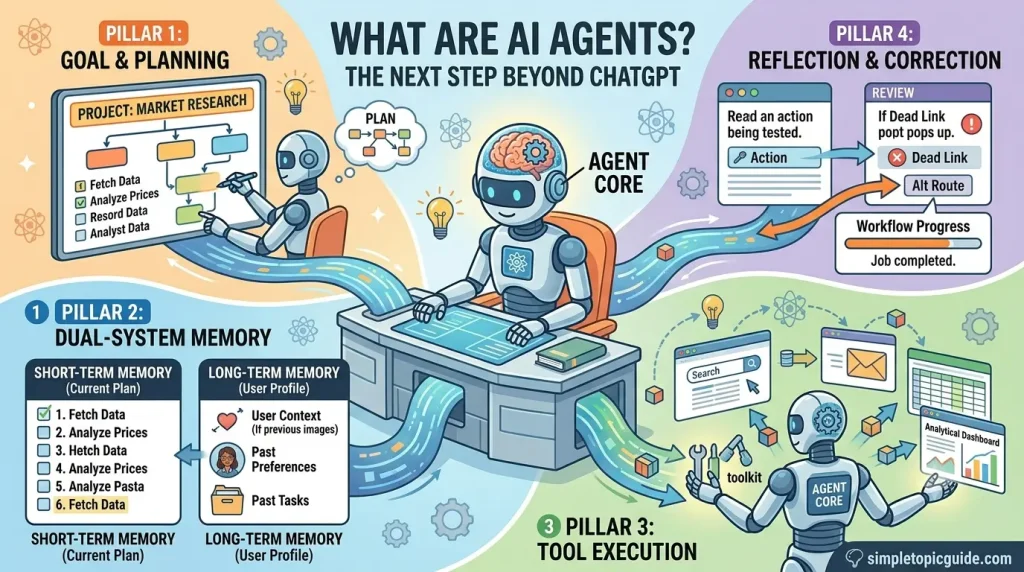
To understand how an autonomous agent can complete complex, multi-step tasks without constant human hand-holding, imagine giving a major project to a highly competent human assistant. An AI agent relies on an interconnected loop of four internal systems working together seamlessly to turn a vague goal into a completed job.
1. Goal Setting and Planning (The Brain)
When you hand an AI agent a massive objective—such as “Research the top five email marketing tools for a small retail storefront”—it doesn’t just start blindly writing down definitions. Its first step is to act as its own project manager.
- Deconstruction: The agent analyzes the primary goal and breaks it down into a logical, sequential checklist of smaller sub-tasks.
- Prioritization: It schedules which steps must happen first (e.g., establishing evaluation criteria, searching for software reviews, and analyzing pricing tiers) before moving forward.
2. Dual-System Memory (The Notebook)
Unlike standard chatbots that treat every conversation as a completely blank slate the moment you hit refresh, an AI agent utilizes a sophisticated, two-part memory ecosystem:
- Short-Term Memory: This acts as the agent’s immediate workspace. It tracks exactly where the agent is on its active checklist, what sub-task it is currently executing, and what immediate data it needs to hold onto for the next click.
- Long-Term Memory: This allows the agent to retain and recall massive amounts of contextual information over extended periods, such as your specific business profile, past tool preferences, and feedback from previous tasks.
3. Tool Execution (The Toolkit)
This is the game-changing component that separates agents from conversational text boxes. An AI agent isn’t locked inside a sealed room; it has an active digital toolkit and knows how to use it.
- Software Interaction: If given permission, an agent can interact with external software applications. It can actively browse the live web, read and write data to Excel spreadsheets, draft emails, use mathematical calculators, or trigger backend webhooks to move files between different platforms.
4. Reflection and Self-Correction (The Quality Check)
If a traditional chatbot runs into an error, hallucinates a fact, or clicks a broken link, it has no internal awareness of its mistake until a human points it out. An AI agent is built with an active, self-correcting feedback loop.
- Dynamic Adjustment: The agent constantly tests its own outputs against its original goal. If it attempts to gather data from a website and hits a login wall or a dead link, it diagnoses the friction point, changes its strategy, and searches for an alternative route without crashing or giving up.
Real-World Examples: Agents in Daily Life
To see how these pillars come together, let’s look at how this technology transforms a couple of everyday, time-consuming tasks.
1. The Autonomous Travel Planner
- The Old Way: You waste three hours opening fifteen separate browser tabs to compare fluctuating flight times, read hotel reviews on multiple forums, filter by price, and cross-reference everything with your open calendar slots.
- The Agent Way: You delegate a simple goal: “Find a weekend trip to Goa under ₹15,000 that aligns with my open schedule next month.” The agent maps out the plan, scans real-time flight data, filters out poorly-rated hotels, cross-references your live calendar, and presents you with the single best end-to-end option.
2. The 24/7 Market Research Assistant
- The Old Way: You spend an entire afternoon scrolling through endless industry articles, extracting data points, weeding out promotional spam, and compiling a summary report manually.
- The Agent Way: An agent actively crawls the web for a specific industry trend, verifies the authority of the sources, structures the data into a clean spreadsheet, drafts a concise executive summary, and files it safely in your drive while you focus on higher-priority work.
Conclusion: Partners That Work for Us
We are rapidly moving past the era where humans have to learn complex prompting formulas just to get a helpful response from a computer. Instead, we are entering a brand-new landscape built on delegation and trust. AI agents represent a massive leap in digital literacy: the transition from tools we merely talk to, to capable digital partners that work alongside us to handle our most repetitive chores.

Shafeeq Gargal is an educator and learning enthusiast dedicated to demystifying complex concepts. With a background in technical problem solving and education, he creates clear, structured guides on personal finance, productivity, and modern technology to help readers build practical everyday skills.