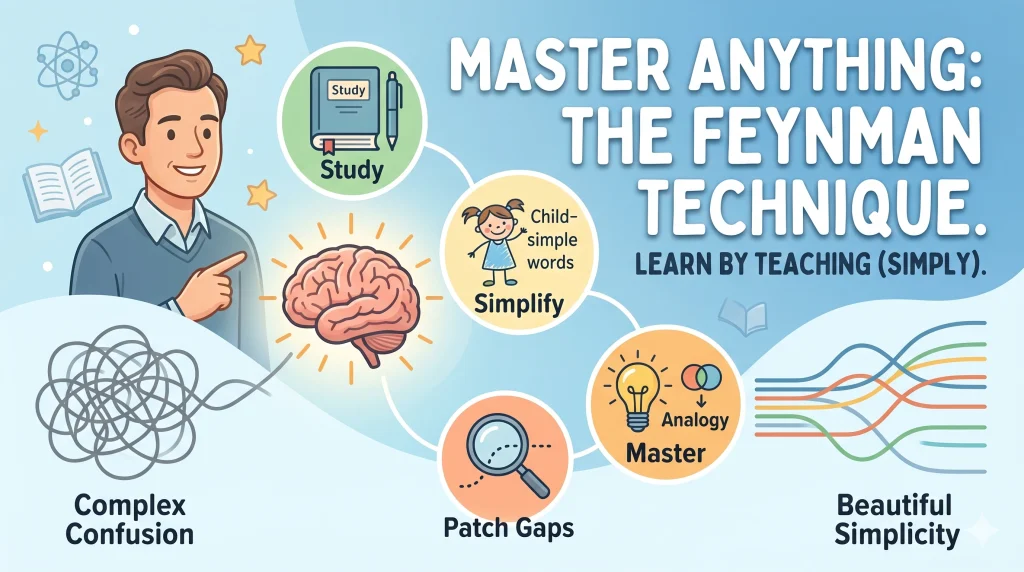
Have you ever spent hours hunched over a textbook, highlighting paragraphs until the pages were a sea of fluorescent yellow, only to realize you couldn’t explain a single concept to a friend five minutes later? It is a deeply frustrating experience, and it happens because traditional studying tricks us. We confuse familiarity with deep understanding—a psychological trap known as the illusion of competence.
The legendary Nobel Prize-winning physicist Richard Feynman noticed this problem early on. Nicknamed the “Great Explainer,” Feynman believed that technical jargon and big words are often just masks we wear to hide our own confusion. His core philosophy was brilliantly simple: if you cannot explain a concept in plain, everyday language, you do not truly understand it.
In this article, we will break down the exact four-step framework Feynman used to master complex ideas effortlessly. By shifting from passive reading to active, simple teaching, you can strip away the fluff, patch your hidden knowledge gaps, and learn absolutely anything faster.
Why Traditional Study Methods Fail
We have all been conditioned to study the wrong way. From a young age, we are taught to reread chapters, write out definitions verbatim, and scroll back through our notes before a major exam. While these methods make us feel like we are working hard, cognitive science shows they are highly inefficient. They rely entirely on passive learning. Your brain isn’t actually processing the information; it is simply recognizing it because it has seen it before.
This creates a dangerous gap in our knowledge. When we rely on specialized terminology or textbook jargon, we often trick ourselves into thinking we comprehend a topic. In reality, we are just memorizing a sequence of words. If someone asks you a question that forces you to step outside that memorized script, the illusion falls apart.
The Feynman Technique breaks this cycle by forcing you to switch to active recall. Instead of asking your brain to look at information, it demands that your brain retrieve and restructure it. By stripping away the comfort blanket of technical terms, you expose your hidden blind spots immediately, forcing you to move past superficial memorization and build genuine, long-term mastery.
The 4 Steps of the Feynman Technique
To bring this technique to life, let’s visualize it as a continuous loop of learning, testing, and refining.
Step 1: Choose a Concept and Study It:The Foundation.
Take a blank sheet of paper and write the name of the topic or concept at the very top. Gather your source materials—whether it’s a textbook, an article, or a video lecture—and write down everything you currently understand about it. Be as comprehensive as possible, using your own initial thoughts to map out the core ideas.
Step 2: Teach It to a 12-Year-Old:The Simplicity Test.
Pretend you are explaining this concept to a middle school student who has zero background in the subject. Write out your explanation from scratch using only simple, everyday language. You cannot use industry terms, acronyms, or complex vocabulary. If you are explaining a tech concept like “the cloud,” you can’t just say “remote servers”—you have to explain what a remote server actually means to a child.
Step 3: Identify Your Knowledge Gaps:The Review Phase.
Read your simple explanation back to yourself. Where did you stumble? Where did you find yourself forced to use a big word because you couldn’t figure out a simpler way to say it? These friction points are your exact knowledge gaps. Go back to your books or research material to restudy only those specific, sticky areas until you can explain them effortlessly.
Step 4: Simplify and Use Analogies:The Final Polish.
Review your final explanation and see if you can compress it even further. To lock the concept into permanent memory, construct a powerful analogy. Connect this new, abstract concept to something tangible that the child already understands (e.g., comparing a cell wall to a castle gate, or inflation to a crowded room where space becomes less valuable). Read it aloud one final time to ensure it flows naturally.
Real-World Examples: The Technique in Action
To understand the true power of this method, let’s look at how it transforms abstract, heavy concepts into simple, unforgettable ideas. Notice how the “Textbook Style” relies on complex vocabulary to hide behind, while the “Feynman Style” strips away the jargon to reveal the actual mechanism.
Example 1: The Greenhouse Effect (Science/Technology)
- The Textbook Style: “Solar radiation strikes Earth’s surface, causing atmospheric greenhouse gases—primarily carbon dioxide, methane, and water vapor—to absorb thermal infrared radiation, trapping heat within the troposphere.”
- The Feynman Style: “Think of the Earth like a car parked in a sunny parking lot with the windows rolled up. Sunlight passes right through the clear glass, warming up the dashboard and seats. But that trapped heat can’t escape back out through the glass, so the inside of the car gets boiling hot. Greenhouse gases act exactly like those closed car windows, keeping our planet warm.”
Example 2: Inflation (Economics/Finance)
- The Textbook Style: “Inflation is a macroeconomic phenomenon characterized by a persistent, broad-based decline in purchasing power, typically driven by aggregate demand outpacing aggregate supply or expansion of the monetary base.”
- The Feynman Style: “Imagine if a magical genie woke everyone up tomorrow and gave them a million dollars cash. Suddenly, everyone runs to the local store to buy a new car. Because the car dealership only has ten cars but hundreds of people want to buy them, the dealer raises the prices through the roof. When money is too easy to get, prices go up, and every single dollar bills lose its buying power.”
The Takeaway: In both examples, the Feynman Style doesn’t lose any accuracy. Instead, it changes the conversation from a test of vocabulary to a test of visualization. If you can picture the closed windows of a car or a crowded dealership, you understand the core mechanics of the concept.
Conclusion: True Mastery is Simple
At its core, the Feynman Technique is a reality check for your brain. It forces you to stop hiding behind complex vocabulary and challenges you to confront what you actually know. True intelligence isn’t about how many big words you can memorize from a textbook; it is about your ability to strip away the noise and express deep truths with beautiful simplicity.
The next time you sit down to study a difficult topic, prepare for a professional presentation, or dive into a new piece of technology, step away from the highlighter. Grab a blank sheet of paper instead. By taking the time to explain the concept simply, you aren’t just memorizing information for a day—you are mastering it for life.
Your Quick-Start Feynman Checklist
Before you hit publish or close your notebook, make sure your study guide passes the ultimate simplicity test:
- [ ] The Headline: Did you write down a single, specific topic at the top of a blank page?
- [ ] The Vocabulary: Did you scrub your explanation clean of all industry jargon and textbook definitions?
- [ ] The Target Audience: Is the language accessible enough that a 12-year-old child could follow along without getting confused?
- [ ] The Diagnosis: Did you actively identify the specific spots where you stumbled or got stuck?
- [ ] The Patch: Did you return to your source material to review and fix those exact knowledge gaps?
- [ ] The Anchor: Did you build at least one clear, real-world analogy to make the abstract concept visual and memorable?
The Ultimate Rule: If you read your explanation out loud and it still sounds like an encyclopedia entry, take one more pass. Simplify the sentences, cut the filler, and keep refining until the core idea stands completely naked and perfectly clear.

Shafeeq Gargal is an educator and learning enthusiast dedicated to demystifying complex concepts. With a background in technical problem solving and education, he creates clear, structured guides on personal finance, productivity, and modern technology to help readers build practical everyday skills.