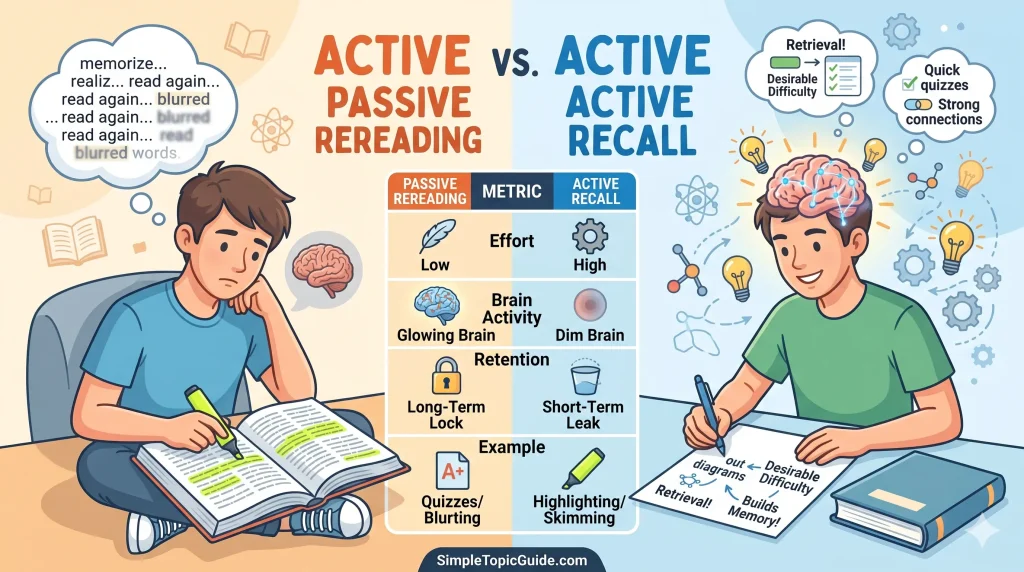
Picture a typical study session: a perfectly clean desk, a freshly opened textbook, and a bright, neon highlighter gripped firmly in your hand.
By the end of the evening, half the page is glowing yellow, your notes look beautiful, and you crawl into bed feeling an immense sense of accomplishment.
But if you closed that book right now, stepped away from your desk, and were asked to reproduce that information completely from scratch, how much of it could you actually recall?
The uncomfortable truth is: probably very little.
Cognitive scientists call this common trap passive rereading. When we review our highlighted notes or skim a chapter over and over, our brains mistake recognition for mastery.
Because the words look familiar on the page, we trick ourselves into thinking the information is locked inside our heads—a dangerous psychological illusion that completely falls apart the moment we sit down for an actual exam or a real-world evaluation.
If you want to truly make knowledge stick, you have to abandon the safety net of comfort-driven studying and switch to a powerhouse cognitive framework known as Active Recall.
Instead of passively pushing information into your brain, active recall demands that you force your brain to retrieve information out of your memory.
In this article, we will dive into the fascinating science of why making your brain struggle through “desirable difficulty” is the ultimate, evidence-based secret to building permanent neural pathways and mastering any subject in a fraction of the time.
The Illusion of Competence: Why Highlighting Fails
We have all been conditioned to study in ways that feel safe, comfortable, and ultimately ineffective. From middle school classrooms to university libraries, the standard approach to learning has long been to read a chapter, run a bright highlighter over key sentences, and review those glowing passages right before a test. While this method makes us feel like we are working hard, cognitive psychology tells a completely different story: it relies entirely on passive learning.
When you highlight text or reread a section of a book, your brain isn’t actually processing the information deeply; it is simply recognizing it. This distinction is crucial. Recognition is the low-energy cognitive process of identifying something that is right in front of you—like recognizing a familiar face in a crowded room. Recall, on the other hand, is the high-energy process of retrieving an idea entirely from within your own memory without looking at it—like trying to remember that person’s name when they aren’t anywhere near you.
This creates a psychological trap known as the illusion of competence. Because your eyes scan the highlighted words easily, your brain whispers, “Ah, I know this. This makes sense.” You mistake the ease of reading for the ease of knowing. In reality, you haven’t built a single permanent neural pathway; you have simply become familiar with the layout of the page. The moment the book is closed and you are asked to explain the concept in your own words, the illusion shatters, leaving you stranded with a blank mind.
The Science: What is “Desirable Difficulty”?
To understand why passive learning fails, we have to look at how the human brain chooses what to remember and what to throw away.
Your brain is a highly efficient machine designed to conserve energy. If a piece of information is incredibly easy to access—like looking down at an open textbook—your brain assumes it doesn’t need to waste energy storing it for the long term.
To create a permanent memory, you must introduce what cognitive scientists call desirable difficulty. Coined by renowned psychologist Robert Bjork, this principle states that learning is deeper and more durable when it requires a measurable amount of mental effort.
The more your brain has to struggle, sweat, and search to retrieve a piece of information, the more firmly that information is anchored into your long-term memory.
Think of your brain exactly like a muscle. You would never expect to build physical strength by sitting on a bench and watching someone else lift weights, nor would you expect results from lifting a feather a thousand times.
You build muscle by exposing it to resistance—by forcing it to handle a weight that makes it struggle. Active recall is the mental equivalent of weightlifting.
By forcing your brain to work through the “desirable difficulty” of pulling information out of a blank mind, you send a powerful evolutionary signal to your brain: “This information was incredibly hard to find, which means it must be vital to our survival. Store it deeply.”
Active vs Passive: A Side-by-Side Comparison
To help you audit your own study habits, let’s look at how active and passive methods stack up against each other.
| Study Metric | Active Recall 🧠 | Passive Rereading 📖 |
| Brain Activity | High (Retrieving information from within) | Low (Absorbing information from the outside) |
| Effort Required | High mental energy (Feels difficult and taxing) | Low mental energy (Feels easy and comfortable) |
| Long-Term Retention | Excellent (Builds permanent neural pathways) | Poor (Information fades within days or hours) |
| Common Examples | Flashcards, practice quizzes, blurred blurting | Highlighting, skimming notes, re-watching videos |
3 Practical Ways to Use Active Recall Every Day
Shifting your study habits from passive to active doesn’t require extra hours at your desk—it simply requires a change in strategy. Here are three highly effective, scientifically proven ways to build “desirable difficulty” into your daily learning routine.
1. The Flashcard System (With a Strict Twist)
Flashcards are the most common active recall tool, but most people use them incorrectly. They read the front of the card, immediately flip it over, see the answer, and think, “Ah yes, I knew that.” This completely bypasses the mental struggle required for deep learning.
- The Right Way: Write a specific, open-ended question on the front of the card rather than just a single term.
- The Golden Rule: Before you turn the card over, you must write your answer down on a scrap piece of paper or say it out loud. You must commit to an answer before exposing yourself to the correct one. This forces your brain to execute a full memory search.
2. The “Blurting” Method
If you prefer writing out notes, the blurting method is an incredibly powerful alternative to traditional skimming. It acts as an immediate diagnostic test for your memory.
- The Right Way: Read a section of a textbook or review a set of notes for 10 to 15 minutes with total focus. Then, close the book completely and push your notes out of sight.
- The Struggle: Take a completely blank sheet of paper and “blurt” out absolutely everything you can remember as fast as possible. Write down definitions, draw quick diagrams, and link ideas together. Do not look back at the source material while doing this.
- The Patch: Once your brain runs out of steam, open your textbook back up. Take a pen of a completely different color (like red or green) and write down the facts you missed or got wrong. This highlights your exact knowledge gaps instantly.
3. Pre-Testing (Testing Before You Learn)
It sounds completely counterintuitive to take a test on a subject you haven’t even studied yet, but cognitive science shows that failing productively is a massive trigger for long-term retention.
- The Right Way: Before you open a brand-new chapter or click on an instructional video, find a quick practice quiz or look at the review questions at the end of the section. Attempt to answer them.
- The Psychology: You will likely guess many of them incorrectly, and that is exactly the point. The active, creative struggle of searching your mind for a potential answer primes your brain’s neural networks. When you finally sit down to read the material, your brain will automatically spot the correct answers with hyper-awareness, locking them in much faster.
Conclusion: Embrace the Friction
Effective learning is fundamentally supposed to feel uncomfortable. If a study session feels completely smooth, easy, and relaxing, you are likely spinning your wheels in the trap of passive learning. True mastery lives in the friction. By replacing your highlighters with blank sheets of paper and active questions, you stop practicing how to look at information and start practicing how to think.
Ditch the neon markers today. Challenge yourself to pick just one difficult concept tonight, shut the textbook, and blurt everything you know onto a blank page. Your brain will thank you for the heavy lifting.
Your Active Recall Checklist
Before you close your notebook, ensure your next study session passes the active testing protocol:
- [ ] No Safety Nets: Did you completely close your books and hide your notes before trying to remember the facts?
- [ ] Active Output: Did you say your answers out loud or write them down before checking if you were correct?
- [ ] The Friction Check: Did the session feel mentally challenging rather than simple and repetitive?
- [ ] The Gap Highlight: Did you use a different color pen or a separate list to explicitly note down your mistakes for a targeted review?

Shafeeq Gargal is an educator and learning enthusiast dedicated to demystifying complex concepts. With a background in technical problem solving and education, he creates clear, structured guides on personal finance, productivity, and modern technology to help readers build practical everyday skills.