Think about how ideas actually form inside your head. When you hear a word like “Summer,” does your brain generate a neat, vertical, bulleted list of text? Probably not. Instead, your mind instantly explodes into a vibrant, multi-directional web of associations: you picture blazing sunshine, hear the crash of ocean waves, taste cold ice cream, and recall memories of open road trips.
Our brains naturally think in these interconnected networks, yet traditional note-taking systems force us to write in rigid, straight, top-to-bottom lines. We cram our dynamic, colorful thoughts into monochrome paragraphs, creating an unnatural bottleneck for our creativity and memory.
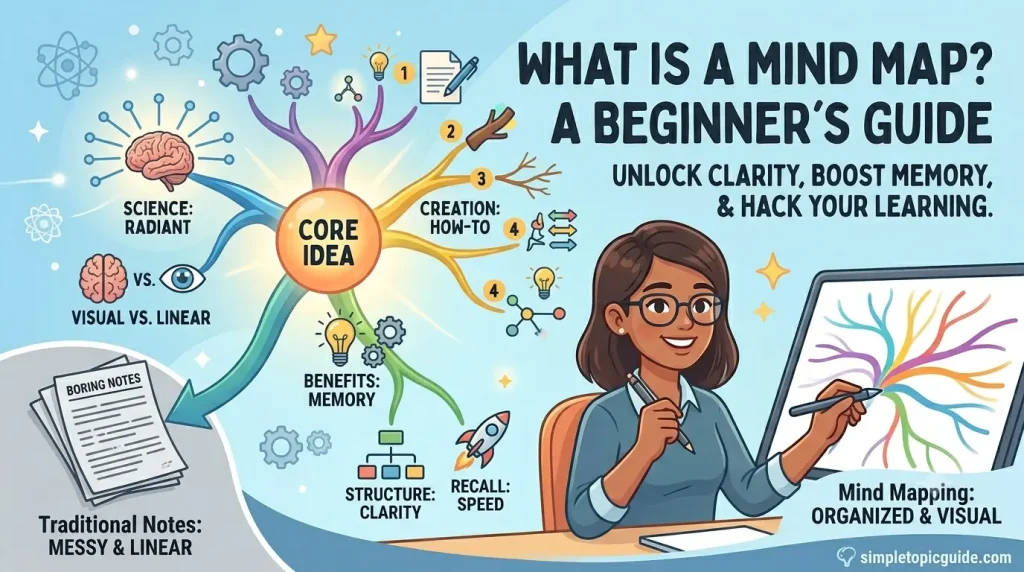
If you want to break free from this mental traffic jam, you need to align your notes with your brain’s natural architecture using a tool called a Mind Map. Coined as a formal learning technique to mirror organic thinking, a mind map replaces boring, linear lists with a visual framework that radiates outward from a single idea.
in this beginner’s guide, we will explore the science behind visual thinking and walk through a simple, four-step process to step away from traditional lists and unlock massive clarity, effortless brainstorming, and bulletproof memory retention.
The Science of Visual Thinking: Linear vs. Radiant
We have all experienced “cognitive fatigue” during a long study or planning session. You stare at a massive wall of handwritten text or typed bullet points, and your eyes begin to glaze over. This happens because standard linear note-taking is fundamentally a chore for your brain. It forces a highly visual, associative organ to process information in a slow, single-file line.
In contrast, your brain naturally operates on a principle known as Radiant Thinking. Every thought, memory, or piece of information inside your head acts as a central sphere, radiating thousands of hooks and connections outward in every direction. When you force these ideas into a straight line, you strip away their context and relationships.
Furthermore, cognitive research shows that the human brain processes images roughly 60,000 times faster than text. When you build a mind map, you are speaking your brain’s native language.
By utilizing shapes, colors, spatial layouts, and keywords, you transform abstract data into a distinct physical landscape. This visual advantage allows you to map out complex information, spot hidden connections between distant topics, and absorb hours of material at a single glance.
How to Build a Mind Map from Scratch
To build a flawless mind map, imagine a tree growing from the ground up: the central idea is your trunk, the major categories are your thick branches, and your supporting details are the smaller twigs. Grab a blank piece of paper, turn it horizontally (landscape mode) to give your mind maximum room to expand, and follow these four steps.
Step 1: Plant the Central Concept
In the absolute center of your page, write down your core topic or the main problem you want to solve in just two or three words. Draw a circle or a box around it to anchor your focus. If you can, sketch a simple icon or doodle next to the words. Because your brain responds powerfully to visual triggers, a central image instantly stimulates your creative thinking and gives your entire map a clear starting point.
Step 2: Grow the Main Branches
Draw thick, curved lines extending outward from your central concept. Each of these lines represents a major category or a primary pillar of your topic. On top of each line, write a single, high-impact keyword. Keep these lines thick and use a distinctly different color for each branch. This immediate color-coding helps your brain organize and categorize different streams of thought without getting overwhelmed.
Step 3: Add Sub-Branches (The Twigs)
From your thick main branches, sprout thinner lines extending further outward. These are your sub-branches, or twigs. This is where you begin to unpack the details, adding secondary data, supporting arguments, or specific examples. You can continue adding layers of smaller twigs as deeply as your topic requires, seamlessly moving from large, abstract ideas down to concrete, granular details.
Step 4: Weaponize Colors and Icons
A great mind map shouldn’t look like a black-and-white outline; it should look like a visual map. Use contrasting colored pens to differentiate your topics at a glance. Whenever possible, swap out words for quick symbols, arrows, or exclamation points to highlight important links between different areas. This spatial arrangement and creative flair are what turn a basic piece of scratch paper into a highly retrievable memory aid.
3 Ways Mind Mapping Saves Your Time
Once you master the basic steps, you can use mind mapping to radically speed up your daily workflows.
1. Crushing Complex Study Topics
Instead of flipping through dozens of pages of linear, crowded textbook notes, a single, comprehensive mind map can compress an entire academic unit into one scannable page. It allows you to see both the big picture and the small details simultaneously, cutting your review time in half.
2. Effortless Project Planning
When starting a new project, a business idea, or a long article, your initial thoughts are usually messy and disorganized. Mind mapping lets you perform an immediate “brain dump” without worrying about chronological order. You can throw your ideas onto the page as they come, naturally grouping and structuring their relationships later.
3. Bulletproof Memory Retention
Because mind maps use spatial layouts, unique colors, and visual hooks, looking at one for just two minutes forms a strong mental image in your mind’s eye. During an exam, a speech, or a professional meeting, your brain can easily “recall” the layout of the paper to retrieve the exact facts you need.
Conclusion: Free Your Thoughts
Writing in straight lines is perfectly fine for reading a book, but it is highly restrictive for brainstorming, planning, and deep learning. Mind mapping frees your thoughts from the single-file line and aligns your work directly with your brain’s natural programming.
Ditch the traditional list today. Grab a blank sheet of paper, write your biggest goal or toughest project in the center, and watch your ideas unfold visually.
Your Visual Thinking Checklist
Before you complete your visual map, make sure it passes the radiant layout test:
- [ ] The Orientation: Did you turn your paper sideways (landscape) to give your branches room to grow?
- [ ] The Anchor: Is your central concept clearly defined in the middle with a bold title or icon?
- [ ] The Framework: Did you use thick, colorful lines to separate your main topics?
- [ ] The Hierarchy: Do your ideas flow naturally from large categories down to small, specific details?
- [ ] The Visual Language: Did you include colors, simple doodles, or connecting arrows instead of just plain text?

Shafeeq Gargal is an educator and learning enthusiast dedicated to demystifying complex concepts. With a background in technical problem solving and education, he creates clear, structured guides on personal finance, productivity, and modern technology to help readers build practical everyday skills.