Life has a habit of throwing unexpected financial curveballs. Whether it’s an urgent car repair, an unforeseen medical bill, a sudden job loss, or home maintenance emergencies, financial surprises are a matter of when, not if.
Without a financial safety net, even a minor crisis can force you into high-interest credit card debt or compel you to take out expensive personal loans. This creates a cycle of stress that can take months or even years to break.
The most effective buffer against life’s unpredictable moments is a 3-month emergency fund. Building this financial cushion isn’t about hoarding wealth or sacrificing all enjoyment today—it is about buying peace of mind, stability, and freedom from financial panic.
What Is an Emergency Fund (and What It Isn’t)
An emergency fund is a dedicated pool of cash reserved strictly for urgent, necessary, and unforeseen living expenses.
To manage your fund effectively, it helps to clearly separate true emergencies from routine or discretionary spending:
| What Is an Emergency 🚨 | What Is NOT an Emergency ❌ |
| Unexpected job loss or income reduction | Annual property taxes or insurance premiums (predictable) |
| Urgent medical or dental procedures | Last-minute vacation deals or holiday shopping |
| Critical car repairs needed to commute to work | Upgrading to the latest smartphone |
| Essential home repairs (e.g., broken heater in winter) | Buying designer clothing on sale |
Key Takeaway: An emergency fund is financial insurance, not a secondary checking account for spontaneous purchases.
How Much Do You Actually Need?
A standard rule of thumb is to save 3 to 6 months’ worth of essential living expenses. If you are single with a stable income, a 3-month fund provides a robust, realistic starting goal before scaling up.
Crucially, “3 months of expenses” does not mean 3 months of your total take-home salary. It means the absolute minimum amount of money required to keep your household running safely for 90 days.
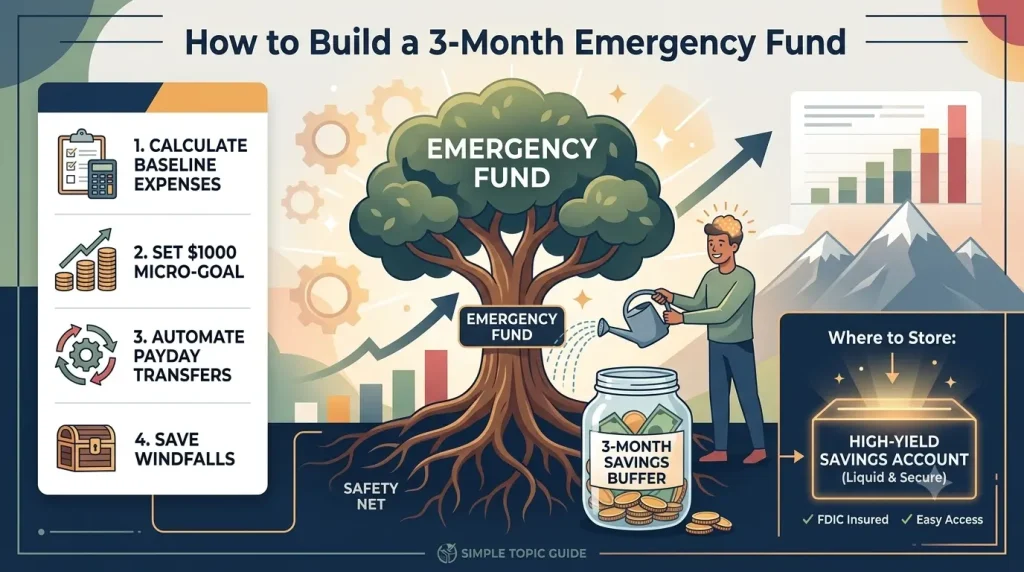
Step 1: Calculate Your Essential Baseline
To find your 3-month target, sum up only your core monthly expenses:
- Housing: Rent or mortgage payment + essential utilities.
- Food: Groceries and basic household staples (exclude restaurant dining out).
- Transportation: Fuel, public transit passes, or basic auto insurance.
- Health & Debt: Minimum debt payments, insurance premiums, and essential medications.
Monthly Essential Expenses  ×  3 Months  =  Your Target Emergency Fund
Example: $2,500/month       ×  3         =  $7,500 Target
4 Practical Steps to Build Your Fund
Building a 3-month cushion might feel daunting if you’re starting from zero. However, by breaking the target down into structured steps, you can make steady, sustainable progress.
1.1. Leverage the 20% Savings Bucket:Budget Allocation.
The most effective way to start funding your safety net is by utilizing a structured framework like the 50/30/20 rule. In our guide on Financial Literacy 101: The 50/30/20 Budgeting Rule Simplified, we break down how 20% of your net income should be directed toward financial goals. Direct this entire 20% allocation into your emergency fund until you reach your baseline target.
2.2. Set a Micro-Goal First:Milestone Strategy.
Don’t focus immediately on the full 3-month target if it feels overwhelming. Aim for a micro-goal of $1,000 first. Reaching $1,000 gives you immediate protection against small, everyday bumps in the road and builds momentum for the larger milestone.
3.3. Automate Your Contributions:Remove Friction.
Relying on willpower to save whatever is left over at the end of the month rarely works. Set up an automated recurring transfer on payday directly from your checking account to your designated emergency account. Treat saving for your future self like an unmissable monthly bill.
4.4. Funnel Unplanned Windfalls:Accelerate Progress.
Accelerate your timeline by redirecting non-standard income straight into your savings pool. Tax refunds, work bonuses, cash gifts, or income from selling unused household items can instantly boost your balance without affecting your day-to-day lifestyle budget.
Where Should You Keep Your Emergency Fund?
Where you store your emergency money is just as important as how much you save. Your emergency fund must satisfy two primary criteria: Liquidity (you can access it quickly) and Capital Preservation (it won’t lose value in a market crash).
1. High-Yield Savings Account (HYSA) — The Ideal Choice
An HYSA is the gold standard for emergency funds. It pays significantly higher interest than a traditional brick-and-mortar savings account while offering FDIC/NCUA insurance protection and complete liquidity. You can withdraw cash within 1–2 business days without penalty.
2. Standard Checking Account — Avoid for Savings
Keeping your emergency stash in your daily checking account creates temptation. When emergency funds blend with everyday spending money, it becomes too easy to accidentally spend your safety net.
3. Stocks, Crypto, or Real Estate — Never Use for Emergency Cash
While stock market investments or cryptocurrencies offer potential long-term growth, they carry market risk. If a financial crisis forces you to liquidate investments during a market downturn, you lock in substantial losses. Emergency funds belong in capital-safe, liquid accounts.
What to Do After Reaching Your 3-Month Target
Once you successfully build your 3-month emergency fund, celebrate the achievement! Reaching this milestone puts you ahead of the vast majority of personal finance beginners.
From here, you have two clear paths depending on your personal risk tolerance:
- Expand to 6 Months: If you are self-employed, work in a volatile industry, or are the sole income earner for a family, consider extending your safety net to 6 months of expenses for extra peace of mind.
- Shift to Long-Term Wealth Building: Once your 3-month cushion is secure, redirect that 20% savings bucket toward high-interest debt repayment, retirement accounts, or long-term index fund investing.
Conclusion: Peace of Mind Is the Real Return
An emergency fund won’t make you rich overnight, nor is it designed to yield high investment returns. Its real return on investment is measured in reduced stress, uninterrupted sleep, and total control when life doesn’t go according to plan.
By setting a clear expense baseline, utilizing a consistent budgeting system, and automating your savings, you turn unpredictable financial crises into minor inconveniences.
Related Guides on Simple Topic Guide:
- Financial Literacy 101: The 50/30/20 Budgeting Rule Simplified
- The Eisenhower Matrix: How to Prioritize When Everything Feels Urgent
- What is Problem Solving? A Complete and Simple Guide

Shafeeq Gargal is an educator and learning enthusiast dedicated to demystifying complex concepts. With a background in technical problem solving and education, he creates clear, structured guides on personal finance, productivity, and modern technology to help readers build practical everyday skills.