We have all been there: an important deadline is looming, yet you find yourself organizing your desk, scrolling aimlessly through social media, or suddenly feeling an intense urge to deep-clean the kitchen.
For decades, society has labeled procrastination as a character flaw—a simple combination of laziness, poor willpower, or bad time management. However, modern neuroscience and behavioral psychology tell a very different story. Procrastination is not a time management problem; it is an emotional regulation problem.
Understanding the neural tug-of-war happening inside your brain is the key to breaking free from chronic delay. By shifting from self-criticism to science-backed techniques like the 5-Minute Rule, you can bypass your brain’s defensive alarm system and regain momentum.
The Brain Science Behind Why We Procrastinate
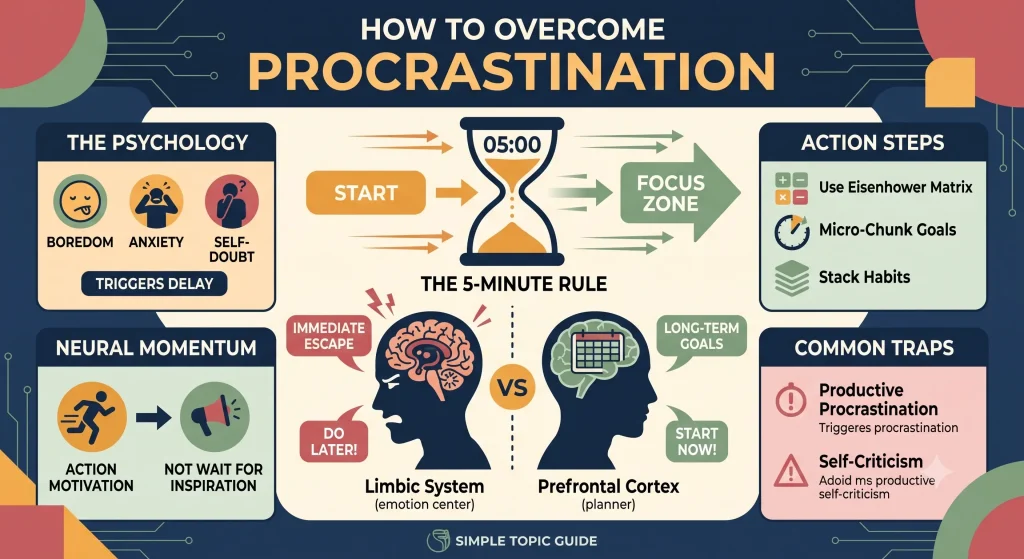
To beat procrastination, you first need to understand the internal conflict happening between two specific areas of your brain every time a daunting task appears:
+-----------------------------------------------------------------------+
| PREFRONTAL CORTEX (The Planner)                                       |
| Thinks long-term, plans goals, understands rewards of completing work. |
+-----------------------------------------------------------------------+
                                   VS
+-----------------------------------------------------------------------+
| LIMBIC SYSTEM (The Emotion Center)                                    |
| Wants immediate pleasure, avoids discomfort, controls "fight or flight."|
+-----------------------------------------------------------------------+
When faced with a task that triggers boredom, anxiety, self-doubt, or fear of failure, your Limbic System perceives that emotional discomfort as a threat. It demands immediate relief, hijacking your executive function and driving you toward low-friction activities (like watching short videos or checking emails) that deliver a quick spike of dopamine.
Your Prefrontal Cortex knows you should work on the project, but because the Limbic System operates on instant gratification, the short-term emotional escape wins out—until the panic of a final deadline forces the Prefrontal Cortex back into control.
What Is the 5-Minute Rule?
The 5-Minute Rule is a cognitive behavioral technique designed to exploit a psychological quirk known as the Zeigarnik Effect.
The rule is deceptively simple: When facing a task you want to avoid, commit to working on it for just 5 minutes. If you want to stop after 5 minutes, you give yourself full permission to quit.
Why It Works Neurologically
- Lowers the Activation Energy: The Limbic System resists high-friction demands (“write a 10-page report”). By reducing the goal to a microscopic action (“type words for 5 minutes”), you eliminate the threat response that causes hesitation.
- Leverages Momentum: The hardest part of any task is almost always the transition from rest to action. Once you cross the starting line, the friction drops significantly.
- Triggers the Zeigarnik Effect: Russian psychologist Bluma Zeigarnik discovered that the human brain experiences psychological tension when a task is left unfinished. Once you start a task, your brain naturally wants to bring it to completion.
Result: More than 80% of the time, once you survive the first 5 minutes, you will naturally continue working long after the timer expires.
4 Practical Steps to Eliminate Procrastination Daily
Combining the 5-Minute Rule with proven productivity frameworks creates an unshakeable daily system:
1.1. Filter Urgency with the Eisenhower Matrix:Prioritization.
Procrastination thrives in ambiguity. When you have twenty tasks and no clear direction, your brain gets overwhelmed and defaults to distraction. Utilize The Eisenhower Matrix to instantly separate urgent, high-impact priorities from trivial noise.
2.2. Micro-Chunk Your Action Plan:Micro-Steps.
Vague goals like “design presentation” trigger intimidation. Break the objective down into atomic actions so small that failure feels impossible (e.g., “Open blank slide deck,” “Title Slide 1,” or “Find 2 image references”).
3.3. Anchor to Established Routines:Habit Stacking.
Instead of relying on sheer willpower, attach your new productive behaviors to existing habits. As explored in How Habits Shape Our Daily Life, linking a 5-minute work block directly to your morning coffee routine reduces the cognitive load required to get started.
4.4. Design for Low Distraction:Environment.
Willpower is a finite resource. Alter your physical and digital environment to increase the friction of your favorite distractions. Put your phone in another room, block social media URLs during focus hours, and keep your workspace clutter-free.
Common Procrastination Traps (And How to Avoid Them)
Even with the best tools, it is easy to slip into disguised forms of delay. Watch out for these three subtle traps:
1. Productive Procrastination
This happens when you complete secondary, low-priority tasks (cleaning, answering non-urgent emails, organizing files) to avoid working on your primary, high-value goal. Remind yourself that motion is not the same as progress.
2. The “I Need to Feel Inspired” Myth
Waiting for the “right mood” or a burst of inspiration before starting is a trap. Action creates motivation, not the other way around. Mood follows movement; once you start acting, the emotional motivation will follow.
3. Harsh Self-Criticism
Beating yourself up for procrastinating creates guilt and stress—the exact negative emotions that trigger the Limbic System to seek escape again. Studies show that practicing self-compassion after a delay makes you significantly less likely to procrastinate on the next task.
Conclusion: Action Precedes Motivation
Overcoming procrastination isn’t about transforming into a tireless robot with perfect willpower. It is about working with your brain’s natural mechanisms instead of fighting against them.
The next time you catch yourself putting off an essential goal, put down the guilt, set a timer for 5 minutes, and make the starting step as small as possible. You don’t need to finish the mountain today—you just need to take the first 5-minute step.
Related Guides on Simple Topic Guide:
- The Eisenhower Matrix: How to Prioritize When Everything Feels Urgent
- How Habits Shape Our Daily Life
- What is Time Management and Why It Matters

Shafeeq Gargal is an educator and learning enthusiast dedicated to demystifying complex concepts. With a background in technical problem solving and education, he creates clear, structured guides on personal finance, productivity, and modern technology to help readers build practical everyday skills.