Over the last few years, artificial intelligence has made an unprecedented leap into everyday life. Tools like ChatGPT, Claude, and Gemini introduced millions of people to the power of Generative AI, allowing users to draft emails, summarize documents, and write computer code in seconds.
However, as impressive as traditional conversational AI is, it has a major fundamental limitation: it only responds when prompted, and its output is strictly conversational. If you ask a standard chatbot to plan a vacation, it will give you a fantastic itinerary—but you still have to go book the flights, reserve the hotel rooms, and manage the schedule yourself.
Enter AI Agents.
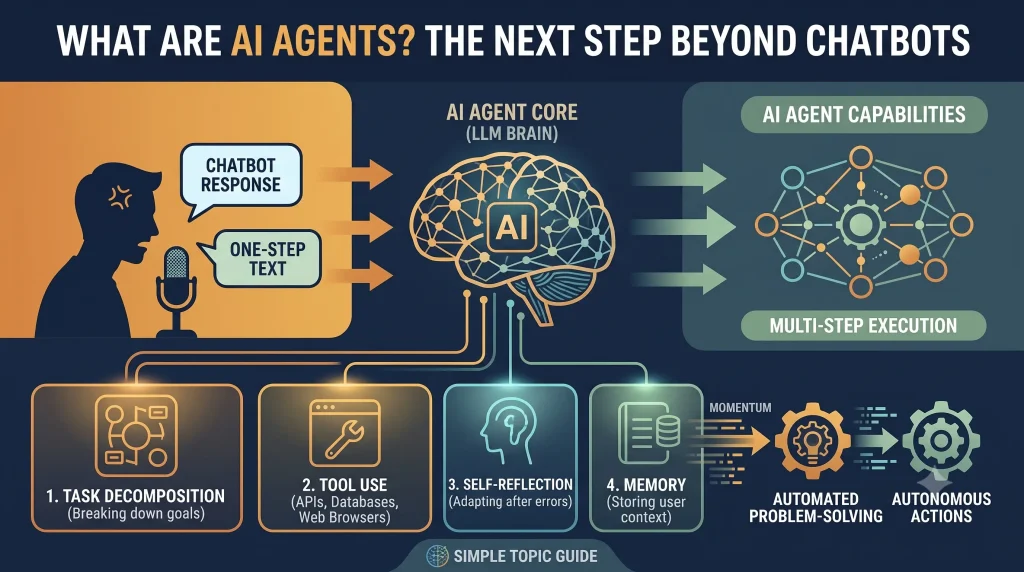
AI agents represent the next major evolutionary phase in artificial intelligence. Instead of just answering questions, AI agents can take independent action, break complex projects down into sub-tasks, use external tools, and execute workflows autonomously to reach a goal.
Chatbots vs. AI Agents: What’s the Difference?
To understand why AI agents are triggering a massive shift in technology, it helps to compare them directly to the generative chatbots we use today:
| Feature | Standard AI Chatbot | Autonomous AI Agent |
| Operating Model | Passive (Reactive to human prompts) | Active (Proactive & Autonomous) |
| Task Execution | Single-turn response generation | Multi-step task execution over time |
| Tool Usage | Restricted to text/chat interface | Uses APIs, web browsers, databases, & apps |
| Problem Solving | Generates text answers | Solves multi-layered, real-world objectives |
| Example Goal | “Suggest a 5-day trip to Tokyo.” | “Book the best flights & hotel for Tokyo under $2,000.” |
How AI Agents Work: The Core Architecture
An AI agent isn’t just a large language model (LLM); it is a complete digital framework built around an LLM that acts as its “brain.”
To understand how an agent functions autonomously, consider its four primary components:
+-----------------------------------------------------------------------+
| 1. THE BRAIN (LLM Core)                                               |
| Processes reasoning, decision-making, and goal decomposition.         |
+-----------------------------------------------------------------------+
                                   │
                                   ▼
+-----------------------------------------------------------------------+
| 2. MEMORY SYSTEM (Short-Term & Long-Term)                            |
| Stores past experiences, user preferences, and intermediate steps.    |
+-----------------------------------------------------------------------+
                                   │
                                   ▼
+-----------------------------------------------------------------------+
| 3. PLANNING ENGINE (Decomposition & Reflection)                      |
| Breaks high-level goals into step-by-step sequential tasks.          |
+-----------------------------------------------------------------------+
                                   │
                                   ▼
+-----------------------------------------------------------------------+
| 4. TOOL INTEGRATION (APIs & Execution)                                |
| Interacts with web browsers, software apps, databases, & code runners.|
+-----------------------------------------------------------------------+
When you give an AI agent a high-level goal, the Planning Engine breaks that goal into actionable steps. The agent then calls external software tools (via APIs) to perform each step, evaluates the results, adjusts its strategy using its Memory System, and continues until the final objective is achieved.
4 Key Capabilities That Power Autonomous AI Agents
1.1. Task Decomposition:Reasoning.
When faced with a massive objective, an agent breaks it down using frameworks like Chain-of-Thought (CoT). Instead of guessing an answer, it builds a checklist: Task A ➔ Task B ➔ Task C.
2.2. Tool & API Utilization:Integration.
Unlike simple text engines, agents can read and write to databases, trigger email software, scrape web pages, execute code, and make financial transactions when authorized.
3.3. Self-Correction & Reflection:Adaptability.
If an agent encounters an error (like a broken web link or a full calendar slot), it doesn’t just stop. It analyzes the error message, adjusts its approach, and tries an alternative route automatically.
4.4. Multi-Agent Systems:Coordination.
Complex systems use networks of specialized AI agents working together. One agent acts as the project manager, another acts as the coder, and a third acts as the quality assurance reviewer.
Real-World Applications Across Industries
AI agents are moving out of research labs and into practical, real-world deployment across several key industries:
1. Software Engineering
Coding agents can be assigned a bug report from a user. The agent accesses the code repository, identifies the broken function, writes a software patch, runs diagnostic tests, and submits a pull request for human approval—all without manual developer intervention.
2. Business Operations & Support
Customer service agents can resolve complex customer requests end-to-end. If a customer requests a refund, the agent verifies order details in the company database, processes the payout through a payment gateway, and updates the inventory log automatically.
3. Personal Productivity
A personal AI agent can monitor your inbox, schedule appointments based on your calendar availability, coordinate with third parties via email, and compile a morning briefing tailored to your priorities.
Challenges Facing the Future of AI Agents
While AI agents hold immense potential, several technical and ethical hurdles remain before they become ubiquitous:
- Error Accumulation: If an agent makes a mistake in Step 1 of a 10-step plan, that error can compound across subsequent steps, causing the execution to fail.
- Security & Permission Control: Giving autonomous software access to emails, financial tools, and corporate data introduces significant cybersecurity risks. Setting strict “human-in-the-loop” boundaries is crucial.
- Computational Cost: Running autonomous agent loops requires continuous, multi-step queries to powerful language models, making complex workflows computationally expensive.
Conclusion: From Assistants to Partners
The transition from passive chatbots to active AI agents marks a fundamental shift in how humans interact with technology. We are moving away from an era where we use computers as passive tools and entering an era where software acts as a capable digital coworker.
By taking over repetitive, multi-step digital workflows, AI agents free up human focus for high-level creative, strategic, and emotional problem solving.
Related Guides on Simple Topic Guide:
- What Are AI Agents? The Next Step Beyond ChatGPT
- What is Quantum Computing? The Future of Processing Power Explained Simply
- How the Internet Works in Simple Words

Shafeeq Gargal is an educator and learning enthusiast dedicated to demystifying complex concepts. With a background in technical problem solving and education, he creates clear, structured guides on personal finance, productivity, and modern technology to help readers build practical everyday skills.