Saying “yes” often feels like the path of least resistance. It pleases a friend, satisfies a manager, avoids an awkward silence, and preserves harmony—or so it seems in the short term.
However, saying yes when you truly want to say no comes at a steep price: your own energy, focus, mental peace, and self-respect. Over time, an inability to draw clear lines leads to burnout, subtle resentment toward the people you care about, and the frustrating feeling that your life belongs to everyone except yourself.
Setting personal boundaries is not about building defensive walls or acting selfishly. It is about defining where you end and where the rest of the world begins. Healthy boundaries protect your well-being while allowing you to build more authentic, sustainable relationships.
Here is a practical, step-by-step roadmap to understanding, establishing, and defending your boundaries with confidence, empathy, and grace.
What Are Personal Boundaries? (And Why They Matter)
At its core, a personal boundary is an imaginary line that marks what is acceptable and what is unacceptable in how others interact with you, your time, your emotions, and your physical space.
Boundaries operate like the property line around a home. They do not prevent visitors from entering; rather, they clarify where the front door is, who is invited inside, and what behavior is welcome on the premises.
+-------------------------------------------------------------------------+
| UNHEALTHY (POROUS) BOUNDARIES                                           |
| • Over-commits out of fear of rejection or guilt.                       |
| • Takes personal responsibility for other people's emotional reactions.  |
| • Constantly drained, overworked, and resentful.                        |
+-------------------------------------------------------------------------+
                                    vs
+-------------------------------------------------------------------------+
| HEALTHY & CLEAR BOUNDARIES                                              |
| • Values own time, values, and mental well-being equally with others.   |
| • Communicates limits clearly, directly, and without excessive apology. |
| • Retains energy for high-priority goals and authentic relationships.   |
+-------------------------------------------------------------------------+
The Three Boundary Profiles:
- Porous Boundaries: You have trouble saying no, over-disclose personal details, and absorb the feelings and problems of everyone around you.
- Rigid Boundaries: You keep everyone at arm’s length, avoid close connection, and rarely ask for help out of fear of vulnerability.
- Healthy Boundaries: You maintain a clear sense of identity, communicate your limits with poise, and allow healthy connection while protecting your core priorities.
The 5 Types of Boundaries You Need to Establish
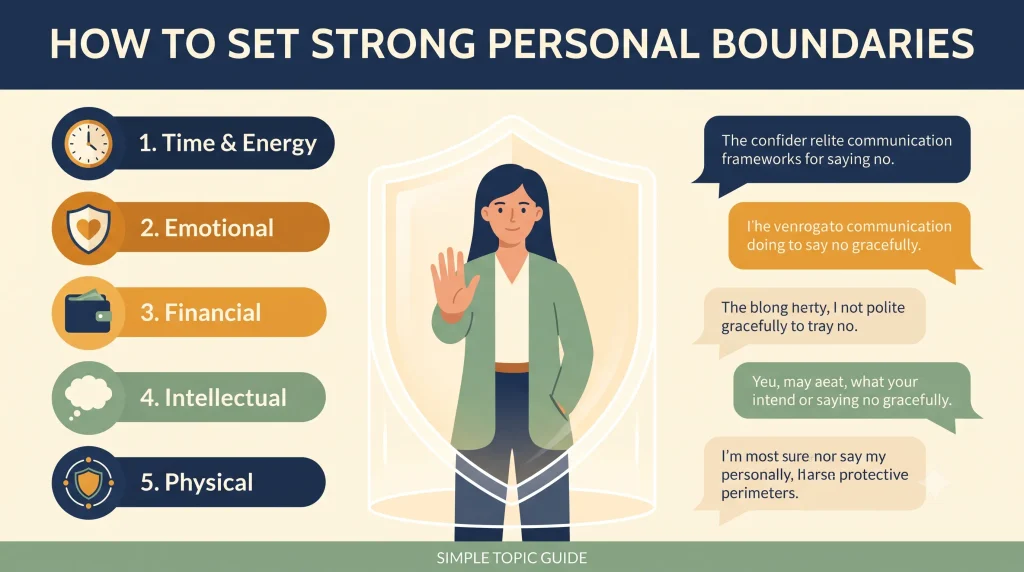
Most people think of boundaries purely in terms of physical personal space. In reality, a well-balanced life requires boundaries across five distinct areas:
| Boundary Type | What It Protects | Real-World Example |
| 1. Time & Energy | Work hours, rest periods, schedule capacity | Declining a weekend work project to protect family rest time. |
| 2. Emotional | Internal feelings, emotional energy, mental load | Stepping away when someone vents constantly without seeking solutions. |
| 3. Material / Financial | Money, personal belongings, physical assets | Refusing to lend money when it puts your personal budget at risk. |
| 4. Intellectual | Thoughts, personal values, viewpoints | Requesting that sensitive political debates be dropped during family meals. |
| 5. Physical | Personal body space, physical touch, privacy | Clearly stating your comfort level regarding hugs or personal physical proximity. |
Why Is Saying “No” So Difficult?
Understanding the psychological obstacles behind people-pleasing makes it much easier to dismantle them:
1. The Disease to Please (Fear of Rejection)
Humans are wired for social belonging. Historically, rejection by the tribe meant danger. Today, that ancient instinct manifests as an irrational fear that turning down a request will lead to abandonment, conflict, or loss of love.
2. The Fallacy of Over-Responsibility
Many people confuse kindness with martyrdom. You might assume that if someone expresses a need, you are personally responsible for fulfilling it. In truth, you are responsible to people (treating them with dignity and fairness), not responsible for people (managing their feelings, choices, or outcomes).
3. Guilt and “Boundary Hangover”
When you first start asserting yourself, you will almost certainly experience a “boundary hangover”—a wave of self-doubt and guilt right after saying no. Recognizing this discomfort as a normal adjustment phase rather than a sign of wrongdoing helps you stay the course.
The Step-by-Step Blueprint to Setting Healthy Boundaries
Setting boundaries requires a shift from passive reaction to intentional communication.
1.1. Identify Your Energy Leaks:Self-Audit.
Pay close attention to feelings of resentment, fatigue, and irritation. Resentment is the primary internal alarm that a boundary has been crossed or needs to be built. Make a list of recurring situations that leave you feeling taken advantage of.
2.2. Define the Rule Before You Need It:Clarity First.
Decide your limits before high-pressure situations arise. Determine your cutoff time for checking work emails, your spending limits on social outings, or how many social commitments you can manage in a weekend.
3.3. Communicate With Calm Precision:Direct Delivery.
Deliver your boundary directly, concisely, and calmly. Avoid defensive body language, rambling over-explanations, or aggressive tones. The clearer your delivery, the less room there is for debate.
4.4. Enforce the Consequence If Ignored:Consistency.
A boundary without enforcement is merely a wish. If someone repeatedly ignores a stated limit, apply an immediate, calm consequence (e.g., end the phone call or excuse yourself from the room).
The Art of Saying “No” Gracefully: 5 Battle-Tested Frameworks
You do not need to be blunt, rude, or hostile to protect your time. Use these practical communication frameworks to decline requests with professional warmth and authority:
+-------------------------------------------------------------------------+
| FRAMEWORK 1: The Warm Decline (Best for Friends & Casual Invites)       |
| "Thank you so much for thinking of me! I'm completely booked right now, |
| so I won't be able to make it. Hope you have a wonderful time!"         |
+-------------------------------------------------------------------------+

+-------------------------------------------------------------------------+
| FRAMEWORK 2: The Alternative Route (Best for Workplace Requests)        |
| "I cannot take on this new report right now without pushing back the   |
| delivery date on our primary project. Which of the two should I focus on?"|
+-------------------------------------------------------------------------+

+-------------------------------------------------------------------------+
| FRAMEWORK 3: The Blanket Policy (Best for High-Pressure Sales/Loans)    |
| "I have a personal policy never to lend money or co-sign loans.         |
| I value our friendship and hope you understand."                        |
+-------------------------------------------------------------------------+

+-------------------------------------------------------------------------+
| FRAMEWORK 4: The Delayed Decision (Best When Caught Off Guard)          |
| "Let me review my schedule and commitments first. I will get back to    |
| you by tomorrow afternoon if it's something I can take on."             |
+-------------------------------------------------------------------------+

+-------------------------------------------------------------------------+
| FRAMEWORK 5: The Empathetic Pivot (Best for Emotional Overload)         |
| "I care about what you're going through, but I don't have the emotional |
| bandwidth to give this conversation the focus it deserves right now."   |
+-------------------------------------------------------------------------+
3 Critical Mistakes to Avoid When Communicating Limits
1. Over-Apologizing and Over-Explaining
When you say, “I am so incredibly sorry, but my cousin’s dog has a vet appointment and then my car might be making a noise, so I probably can’t…”, you invite negotiation. People-pleasers over-explain to soften the blow, but detailed excuses actually create loopholes for the other person to solve your problem and pressure you into saying yes.
2. Waiting Until You Reach a Breaking Point
Setting a boundary when you are already exhausted or angry usually results in an emotional explosion. Set boundaries when you are calm, rational, and collected—not when your patience has already run out.
3. Expecting Instant Universal Applause
When you begin asserting your limits, some people—particularly those who benefited from your lack of boundaries—will push back, act offended, or try to guilt-trip you. Stand firm. Their discomfort is not proof that you did something wrong; it is simply proof that the old, unbalanced dynamic is shifting.
Conclusion: Boundaries Are the Ultimate Form of Self-Respect
Setting boundaries is not an act of aggression against others; it is an act of care toward yourself and the life you are actively building.
When you learn to say “no” to trivial distractions, emotional drain, and unreasonable demands, you create space to say a wholehearted, energetic “YES” to your health, your core goals, your authentic relationships, and your peace of mind.
Start small today. Pick one low-stakes situation where you normally cave, apply one of the gentle decline frameworks, and give yourself permission to protect your energy.
Related Guides on Simple Topic Guide:
- The Art of Negotiation in Daily Life: Strategies for Beginners
- The Eisenhower Matrix: How to Prioritize When Everything Feels Urgent
- How to Build Emotional Resilience: A Beginner’s Guide

Shafeeq Gargal is an educator and learning enthusiast dedicated to demystifying complex concepts. With a background in technical problem solving and education, he creates clear, structured guides on personal finance, productivity, and modern technology to help readers build practical everyday skills.